Broadcom vs. Allstate: How VMware Customers Became Legal Targets — and Why Delaying an Exit Is Risky
December 20, 2025
This week’s lawsuit may be captioned VMware LLC v. Allstate Insurance Company, but let’s be precise about what is really happening.
This is Broadcom vs. Allstate — and by extension, Broadcom vs. every large VMware customer still assuming audits are negotiable.
Broadcom’s VMware subsidiary has filed a federal lawsuit accusing Allstate of obstructing a contractual software licensing audit, failing to provide required deployment data, and attempting to unilaterally declare the audit “complete” without vendor verification.
If that sounds procedural, it isn’t.
This case is a clear signal of how Broadcom intends to enforce VMware contracts going forward: strictly, aggressively, and — when challenged — in court.
The Lawsuit in Plain Terms
Broadcom-owned VMware alleges that Allstate violated multiple binding license agreements by:
- Delaying or failing to deliver required usage reports
- Refusing to provide access to systems and records
- Attempting to close the audit by claiming VMware software had been removed
According to the complaint, this conduct:
“Impeded VMware’s ability to determine whether Allstate was in compliance with its licensing obligations.”
That single sentence should unsettle every CIO running VMware at scale.
The Contracts: Old Paper, New Teeth
One of the most dangerous assumptions in enterprise IT is that legacy contracts lose force over time.
Broadcom is proving the opposite.
The lawsuit cites:
- A Master End User License Agreement from 2008
- A 2019 Enterprise License Agreement
- A 2022 amendment extending rights through July 29, 2025
These agreements require Allstate to:
- “Maintain complete and accurate records of VMware software deployment”
- “Provide such records upon request”
- “Permit VMware or its designee to verify compliance through audit”
Those clauses were never symbolic.
Broadcom is now enforcing them literally.
The Audit Timeline: Where Things Broke Down
March 4, 2025 — Formal Audit Notice
VMware notified Allstate that a formal audit was being initiated and warned that:
“Any changes in its environment during the license review process must be reported promptly.”
This matters. Broadcom later argues that environmental changes without disclosure undermine audit integrity.
May 5, 2025 — Audit Kickoff
Broadcom’s audit partner, Connor Consulting, conducted a kickoff call and delivered:
- A technical questionnaire
- A deployment workbook
- Audit scripts for validating VMware usage
This was not vague guidance. The tooling and expectations were explicit.
May–August 2025 — Repeated Delays
According to the complaint:
“Allstate acknowledged receipt of the audit materials but stated it could not meet the requested timelines.”
VMware alleges repeated follow-ups across May, June, and July, with Allstate ultimately committing to an August 29 deadline — which passed without delivery.
From a legal standpoint, this is where delay becomes evidence.
September 12, 2025 — The Nuclear Claim
Allstate allegedly told the auditor that:
“VMware had been removed from all devices.”
It further stated that the audit scripts:
“Depended on having VMware components running in the environment,”
which Allstate said no longer existed.
This is the pivotal moment in the case.
Broadcom’s position is unambiguous:
You cannot erase audit obligations by uninstalling the software mid-review.
October 1, 2025 — Allstate Declares Victory
According to VMware, Allstate declared the audit:
“Complete and satisfied, in compliance with the contractual entitlements, with no further action or obligation from Allstate.”
Broadcom’s response was not a counter-email.
It was a lawsuit.
What Broadcom Is Asking the Court to Do
This is not a symbolic filing.
Broadcom is seeking:
- Court-ordered access to Allstate’s records, systems, and devices
- An injunction preventing destruction or alteration of audit evidence
- Damages, to be determined at trial
- A judicial declaration that Allstate breached its contractual duties
In short, Broadcom wants a judge to force completion of the audit.
That should alarm anyone who still believes audits are merely commercial negotiations.
Why This Is a Turning Point for VMware Customers
1. Broadcom Is Willing to Litigate Audits
Many enterprises operate under the assumption that audits are uncomfortable but ultimately negotiable.
This lawsuit says otherwise.
Broadcom is demonstrating that audit clauses are enforcement mechanisms — not suggestions.
2. “We Decommissioned It” Is Not a Defense
The notion that uninstalling software ends compliance obligations is being directly challenged.
If the court agrees with Broadcom, it establishes a dangerous precedent for customers:
Historical usage still matters — and must remain auditable.
3. Time Is No Shield
These agreements span nearly two decades.
Broadcom is showing that:
- Old contracts still bind
- Amendments extend liability
- Institutional memory failures are not legal excuses
A Deeper Issue: This Is an Attack on Enterprise Sovereignty
There is a more unsettling implication in Broadcom vs. Allstate that goes beyond audits, contracts, or licensing fees.
This lawsuit challenges a long-held assumption in enterprise IT:
That a private cloud is truly private.
For years, enterprises justified VMware on-prem and private cloud deployments on the belief that they retained sovereignty — control over infrastructure, data, timing, and internal processes. The understanding was clear: this is our environment, governed on our terms.
The Broadcom lawsuit undermines that premise.
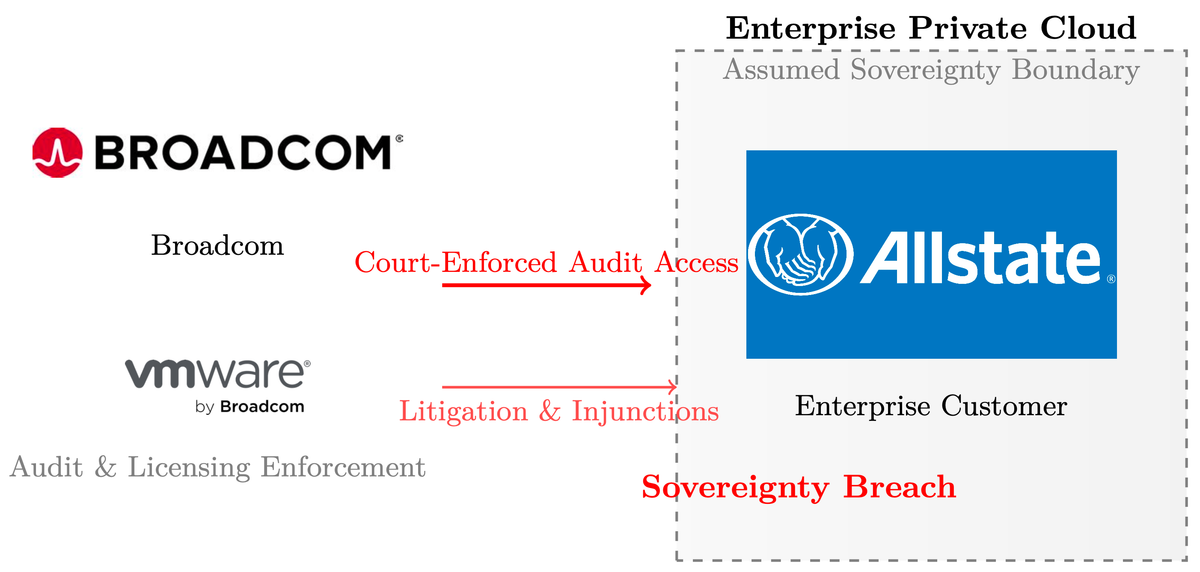
By seeking court-ordered access to systems, records, and devices, Broadcom is asserting that contractual audit rights can override operational autonomy — even inside what customers believed was their own private cloud.
This is no longer just about compliance.
It is about who ultimately has authority inside your infrastructure.
The Private Cloud Illusion
Broadcom’s position sends a stark message:
Even if:
- The hardware is yours
- The data is yours
- The workloads are yours
- The cloud is “private”
Broadcom still claims the right to force its way inside your organization — legally, procedurally, and operationally — to verify its commercial interests.
Audit scripts.
System access.
Historical records.
Court-backed enforcement.
This is vendor intrusion backed by litigation.
You Are No Longer “Safe” Behind the Firewall
The most dangerous misconception exposed by this case is the idea that on-premises equals insulation.
The Allstate lawsuit demonstrates that:
- Firewalls do not block audit rights
- Decommissioning does not end obligations
- Private infrastructure does not prevent external enforcement
- Internal governance does not supersede vendor contracts
Broadcom is effectively saying:
If our software ever ran in your environment, your environment remains auditable — indefinitely, if the contract allows.
From Software Vendor to Internal Actor
Viewed through this lens, Broadcom is no longer behaving as a traditional software supplier.
It is positioning itself as:
- A persistent compliance authority
- An external actor with legal standing inside customer environments
- A party that can compel disclosure, access, and operational transparency
This erodes the concept of enterprise independence.
For organizations in regulated industries, critical infrastructure, financial services, healthcare, or government-adjacent sectors, the implications are profound.
What Enterprises Should Do Now
If you are a VMware customer, treat this case as a warning shot.
Immediately:
- Inventory all VMware deployments — including retired environments
- Review audit clauses with legal, not just procurement
- Preserve historical usage and entitlement data
- Establish a formal audit response and escalation playbook
- Assume enforcement, not accommodation
Because Broadcom clearly is.
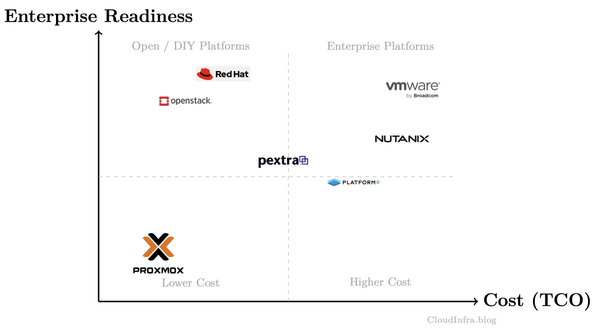
Where Do VMware Customers Go Next? Exploring the Exits
If the Broadcom audit strategy has you rethinking your VMware dependency, there are multiple paths forward — each with trade-offs in cost, complexity, and risk. Below is a high-level overview.
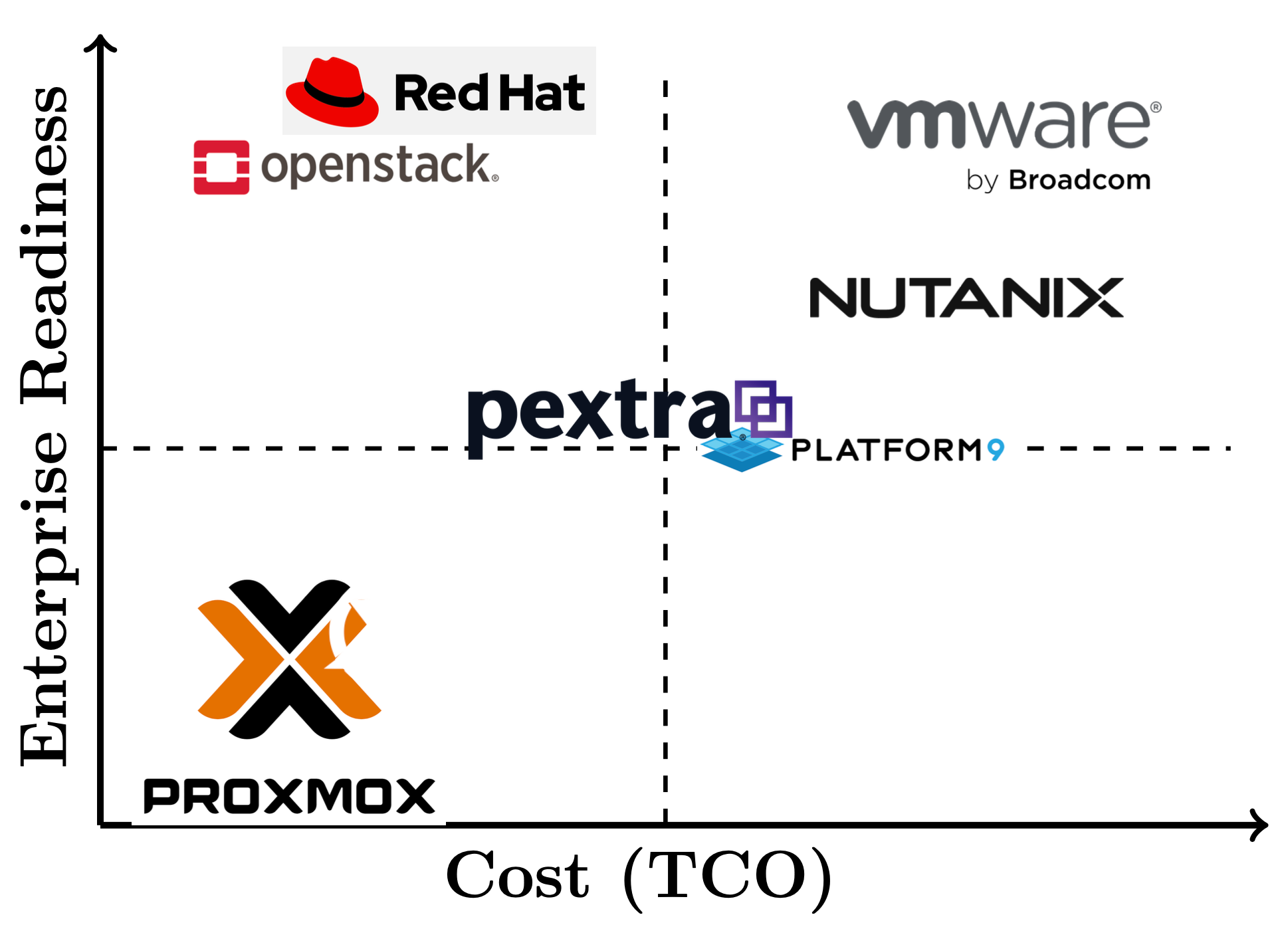
1. Nutanix / Hyperconverged Infrastructure (HCI) — Lateral Movement
Overview:
Nutanix provides a software-defined HCI platform integrating compute, storage, and networking. For VMware customers, this is largely a lateral move — you stay within hyperconverged infrastructure, often continuing to run ESXi.
Pros:
- Familiar VMware tooling can often be reused
- Vendor-agnostic hypervisor support (AHV, ESXi optional)
- Simplified hybrid management
Cons:
- Minimal reduction in vendor lock-in if continuing to run ESXi
- Licensing and support contracts still required
- Migration complexity for large estates
Learn more: https://www.nutanix.com/
2. OpenStack / Cloud-Native Infrastructure — Complex and Operationally Heavy
Overview:
OpenStack is an open-source cloud platform for building private and hybrid clouds. It offers full control but comes with substantial operational overhead.
Pros:
- Full sovereignty and control over infrastructure
- Avoids vendor lock-in
- Large open-source ecosystem
Cons:
- High operational complexity — requires specialized expertise
- Support options may be limited or require third-party vendors
- Migration of legacy VMware workloads is substantial
Learn more: https://www.openstack.org/
3. Pextra Cloud — Modern, Scalable, Built by Ex-VMware Team
Overview:
Pextra Cloud is a modern enterprise cloud platform designed for hybrid and multi-cloud environments. Built by a team of former VMware engineers, it emphasizes sovereignty, operational simplicity, and scalability, making it a strong alternative for organizations looking to exit VMware.
Pros:
- Modern, cloud-native architecture with hybrid/multi-cloud support
- Vendor-neutral, sovereignty-first design
- Simplified migration for VMware workloads
- Built by ex-VMware engineers — understands enterprise pain points
Cons:
- Newer platform with a smaller ecosystem than incumbents
- Fewer large-scale enterprise case studies
- Early adopter risk
Learn more: https://pextra.cloud
4. Platform9 — Managed OpenStack / Kubernetes Alternative
Overview:
Platform9 offers a SaaS-managed approach to OpenStack and Kubernetes, enabling private cloud control without heavy operational burden.
Pros:
- Managed service reduces operational complexity of OpenStack/Kubernetes
- Hybrid and multi-cloud support
- Enterprise-grade SLA and support
Cons:
- Less control than fully self-managed OpenStack
- Migration requires planning and tooling
- Partial vendor dependence remains
Learn more: https://platform9.com
5. KVM / Linux-Based Virtualization
Overview:
Kernel-based Virtual Machine (KVM) is a free, open-source hypervisor built into Linux, widely used for enterprise virtualization.
Pros:
- Fully open-source, no vendor lock-in
- Strong community and enterprise support via Red Hat, SUSE, Canonical
- Can integrate with existing Linux-based operations
Cons:
- Migration tooling less mature than VMware vMotion
- Requires Linux expertise for operational management
- Limited vendor ecosystem compared to VMware
Learn more: https://www.linux-kvm.org/page/Main_Page
6. Public Cloud Migration (AWS, Azure, GCP)
Overview:
Shift workloads from VMware on-premises to public cloud services using native virtualization or VMware Cloud offerings.
Pros:
- Reduces dependency on on-prem VMware entirely (if using cloud-native)
- Offers flexibility, elasticity, and managed services
- Can leverage VMware Cloud on AWS if partial continuity is needed
Cons:
- Potentially higher ongoing OpEx
- Migration and refactoring costs can be significant
- Cloud provider lock-in risk if not designed properly
Learn more:
CIO Takeaway
Every exit path involves trade-offs. Key questions:
- Sovereignty: Do you want full control without vendor enforcement inside your environment?
- Migration Complexity: Can you afford the operational and financial cost of moving workloads?
- Audit and Compliance Risk: Does the new platform reduce exposure to vendor litigation?
- Long-Term Strategy: Are you planning hybrid, multi-cloud, or fully cloud-native operations?
Given Broadcom’s aggressive enforcement posture, now is the time to evaluate these options, develop a roadmap, and prioritize sovereignty, simplicity, and operational independence.
Final Thought: This Isn’t About Allstate
Allstate is simply the first large enterprise willing — or forced — to let this play out publicly.
The real message is broader:
Under Broadcom, VMware audits are no longer a back-office inconvenience.
They are a mechanism for forced access into customer environments, backed by courts and contracts.
If you believed your private cloud guaranteed sovereignty, this lawsuit proves otherwise.
The question is no longer if Broadcom can force its way inside your organization.
It’s whether you are willing to let it — or whether it’s time to jump ship.
References
- VMware LLC v. Allstate Insurance Company, Federal Court Filing, 2025. https://www.insurancebusinessmag.com/us/news/legal-insights/vmware-sues-allstate-over-alleged-obstruction-of-software-licensing-audit-560605.aspx
- Broadcom Inc. Corporate Overview and VMware Acquisition Information. https://www.broadcom.com/company/newsroom
- Nutanix Hyperconverged Infrastructure Overview. https://www.nutanix.com/
- OpenStack Open Source Cloud Platform. https://www.openstack.org/
- Pextra Cloud – Hybrid & Multi-Cloud Platform. https://pextra.cloud
- Platform9 Managed OpenStack & Kubernetes Platform. https://platform9.com
- KVM (Kernel-based Virtual Machine) Documentation. https://www.linux-kvm.org/page/Main_Page
- AWS VMware Cloud Overview. https://aws.amazon.com/vmware/
- Azure VMware Solution Overview. https://azure.microsoft.com/en-us/solutions/azure-vmware/
- Google Cloud VMware Engine Overview. https://cloud.google.com/vmware-engine
- Cloud Infra Blog: Fidelity vs. Broadcom Case Analysis. https://cloudinfra.blog/fidelity-vs-broadcom-the-lawsuit-that-should-terrify-every-vmware-customer/