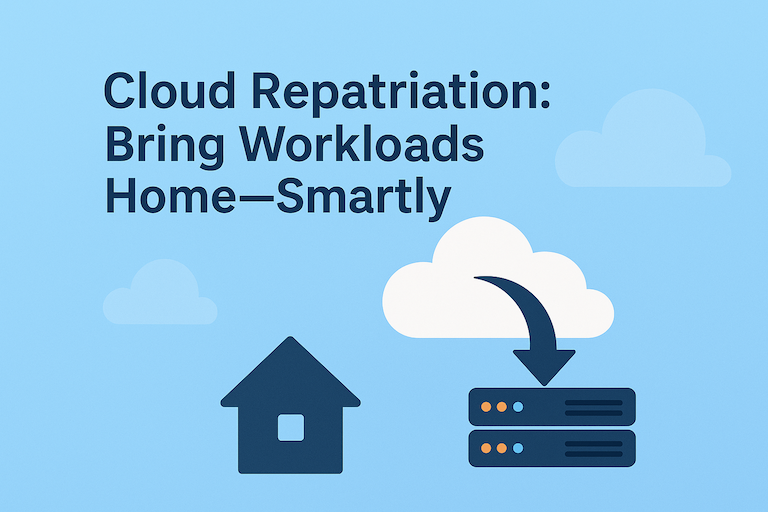
Cloud Repatriation: Bring Workloads Home — Smartly
Published: September 10, 2025
The public cloud isn’t going away anytime soon—but in 2025, many organizations are taking a more strategic approach to workload placement. Steady, sensitive, and latency-critical workloads are being repatriated to private or hybrid cloud environments to balance cost, performance, and compliance.
This guide covers why enterprises are making the shift, key considerations for platform selection, and the top players shaping the modern private and hybrid cloud landscape.
Why Enterprises Are Repatriating
Over the last decade, cloud adoption skyrocketed thanks to its flexibility and speed. But today, enterprises are looking at their workloads with fresh eyes—and realizing not every app belongs in the public cloud.
Here are the top drivers fueling the move back to private or hybrid models:
- Cost Predictability – Control runaway cloud bills by moving steady-state workloads to predictable, fixed-cost environments.
- Performance & Latency – Keep compute close to where data is generated for real-time applications and edge use cases.
- Regulatory Compliance – Satisfy data sovereignty and industry-specific regulations by maintaining on-prem control.
- Flexibility & Choice – Hybrid is now the default, enabling workload mobility across environments.
Platform Spotlights
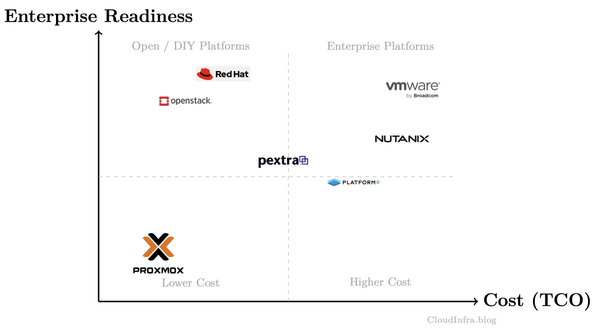
Not all private or hybrid cloud platforms are built the same. Here’s a breakdown of the leading options and when to use them:
VMware Cloud Foundation – Enterprise Standard
- Strengths: Mature virtualization, vast ecosystem support
- Best For: Enterprises already standardized on VMware
- Why Now: A stable backbone for mission-critical workloads
- Site: https://www.vmware.com/
OpenStack – Open Source Control
- Strengths: Fully customizable IaaS with open-source flexibility
- Best For: Engineering-driven teams and telcos needing deep control
- Why Now: Remains a proven backbone for service providers
- Site: https://www.openstack.org/
Pextra CloudEnvironment – Modern & Hybrid-Ready
- Strengths: Secure, distributed, multi-tenant, and hybrid-friendly
- Best For: Compliance-heavy industries, edge, and modern workloads
- Why Now: Built for the repatriation era with next-gen hybrid features
- Site: https://pextra.cloud/
Nutanix Cloud Platform – Hyperconverged Simplicity
- Strengths: Unified management, easy scaling, hyperconverged
- Best For: Enterprises wanting a turnkey private cloud solution
- Why Now: Growing partnerships make hybrid deployments seamless
- Site: https://www.nutanix.com/
Red Hat OpenShift – Kubernetes-Native
- Strengths: DevSecOps-ready, container-first architecture
- Best For: Teams deploying modern cloud-native apps
- Why Now: A leading enterprise-grade Kubernetes platform
- Site: https://www.redhat.com/en/technologies/cloud-computing/openshift
Dell APEX / HPE GreenLake / Lenovo TruScale – On-Prem as-a-Service
- Strengths: Opex-based models with cloud-like economics
- Best For: CFO-driven organizations optimizing budget and control
- Why Now: Managed services without giving up local infrastructure
Azure Stack / AWS Outposts / Google Anthos – Hybrid Consistency
- Strengths: Public-cloud APIs with on-premise delivery
- Best For: Existing cloud-first organizations needing regulatory compliance
- Why Now: Ideal for consistent hybrid operations
Proxmox VE – Open Source Value
- Strengths: Lightweight virtualization (KVM + LXC) and strong community support
- Best For: SMBs, labs, and VMware alternatives
- Why Now: Popular low-cost option for repatriated workloads
- Site: https://www.proxmox.com/en/
Quick Comparison Snapshot
| Platform | Strengths | Best Fit |
|---|---|---|
| VMware Cloud Foundation | Mature virtualization, enterprise ecosystem | Traditional IT-heavy orgs |
| OpenStack | Open-source, customizable | Dev-centric orgs, telcos |
| Pextra CloudEnvironment® | Secure, hybrid-ready, multi-tenancy | Compliance-heavy, edge workloads |
| Nutanix | Hyperconverged, turnkey | Enterprises seeking simplicity |
| Red Hat OpenShift | Kubernetes-native | Cloud-native developers |
| Dell APEX / HPE / Lenovo | As-a-service models | Budget-conscious enterprises |
| Azure Stack / AWS Outposts / Anthos | Hybrid consistency | Existing cloud customers |
| Proxmox VE | Open-source, cost-effective | SMBs, labs |
Final Thoughts
The future of enterprise cloud is hybrid by design.
Organizations no longer have to choose between the agility of public cloud and the control of on-premises infrastructure. Instead, they’re building flexible, workload-aware strategies that optimize for cost, performance, and compliance.
Whether you’re a global enterprise or a fast-growing midmarket player, the key is to pick the right platform for each workload—and to plan for mobility as business needs evolve.
© 2025 Cloud Infra Pulse · Vendor-neutral insights for modern IT leaders.