Comprehensive Analysis of Broadcom's VMware License Pricing Changes and Their Impact
Posted on September 09, 2025
Since Broadcom's acquisition of VMware in November 2023, the technology industry has closely monitored the subsequent transformations in licensing and pricing structures. Announced initially in December 2023 and refined through subsequent updates in 2024 and 2025, these changes mark a significant departure from VMware's traditional model, shifting from perpetual licenses to subscription-based frameworks and introducing bundled offerings. This detailed blog elucidates the specifics of the announcement, clarifies the revised pricing structure, and provides an in-depth analysis of the potential ramifications for the private cloud community and academic institutions, drawing on industry reports and stakeholder feedback.
The Announcement and Key Changes
Broadcom's acquisition of VMware, finalized on November 22, 2023, for approximately $61 billion, prompted a strategic overhaul of VMware's licensing model. The initial announcement on December 11, 2023, declared the end of perpetual license sales, mandating a transition to subscription-only contracts. This policy shift aimed to align VMware with industry trends toward recurring revenue streams, a move Broadcom has employed successfully in prior acquisitions like CA Technologies and Symantec. Subsequent updates, detailed in press releases and VMware's official documentation, included the following key changes:
- Subscription-Only Model: Effective from early 2024, new purchases and ongoing support require subscriptions, with perpetual licenses no longer receiving updates or patches post-expiration.
- Product Portfolio Consolidation: Broadcom reduced VMware's offerings from over 8,000 stock-keeping units to four primary bundles—VMware Cloud Foundation (VCF), vSphere Foundation, vSphere Standard (discontinued July 31, 2025), and vSphere Enterprise Plus (new entry-level tier)—streamlining the catalog to focus on integrated solutions.
- Core Licensing Adjustments: Starting April 10, 2025, the minimum core requirement per CPU increased from 16 to 72, impacting pricing for smaller deployments. This change, outlined in a memo to partners like Arrow, ensures a baseline capacity even for underutilized servers.
- Late Renewal Penalties: Introduced in 2025, a 20% surcharge on the first-year subscription price applies to renewals past the anniversary date, enforcing timely compliance.
- Hyperscaler Integration: Effective November 1, 2025, customers using Azure VMware Solution or similar services must procure portable VCF subscriptions directly from Broadcom, discontinuing bundled licensing through hyperscalers post-October 15, 2025.
These modifications reflect Broadcom's intent to optimize revenue and focus on high-value, scalable offerings, a strategy consistent with its historical acquisition approach.
New Pricing Details
The revised pricing structure introduces a complex landscape with both reductions and significant increases, depending on customer profiles:
- Subscription Pricing Baseline: The per-core annual fee for VCF was reduced by 50%, dropping from $700 to $350, as publicized by Broadcom. However, this reduction applies only to bundled purchases, and the base pricing clarity remains elusive, raising questions about actual savings.
- Cost Increases: Industry reports indicate price hikes ranging from 150% to 1,200% for customers transitioning from perpetual or standalone licenses. For example, a UK university reported a 1,250% increase, with its annual support cost rising from £40,000 to £500,000 under the new VCF bundle mandate. SMBs with eight-core CPUs now face costs for 72 cores, significantly inflating expenses.
- Minimum Core Impact: The 72-core minimum, effective since April 2025, disproportionately affects smaller private cloud operators. A server with 10 cores incurs the same licensing cost as one with 72, leading to overbuying and potential wastage.
- Negotiation Dynamics: Discounts are available through direct negotiations with Broadcom, but terms vary, with larger enterprises securing better rates. European customers, as noted by the European Cloud Competition Observatory (ECCO), have faced increases of 800% to 1,500%, compounded by the lack of perpetual or pay-as-you-go options.
- Support Transition: Existing perpetual license holders can continue using their software but must subscribe for updates, security patches, and technical support, adding an ongoing financial burden.
These pricing shifts underscore Broadcom's focus on recurring revenue, though the variability in impact highlights disparities across customer segments.
Potential Impact on the Private Cloud Community
The private cloud community, which relies heavily on VMware for secure, on-premises virtualization, faces multifaceted challenges from these changes:
- Cost Escalation for SMBs: Small and medium-sized businesses (SMBs), often operating private clouds with modest infrastructure, are particularly affected by the 72-core minimum. A solution provider CTO cited in CRN noted that this discourages cost-conscious SMBs, with a single eight-core server now costing as much as a 72-core deployment—approximately $25,200 annually at $350 per core for VCF, compared to $5,600 previously. This could force migrations to open-source alternatives like Proxmox VE or KVM, incurring transition costs and potential data migration risks.
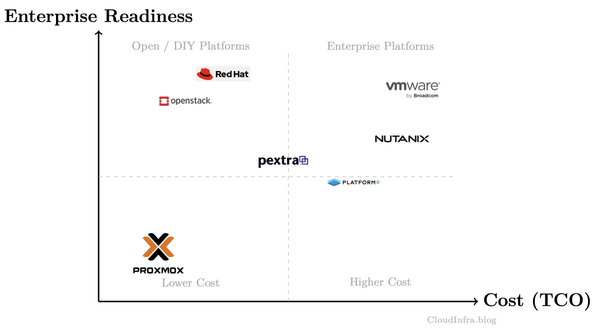
- Large Enterprise Adjustments: Larger organizations with extensive private cloud deployments may absorb the increases but face vendor lock-in risks. The bundled VCF model, requiring purchases of NSX and vSAN even if unnecessary, could prompt hybrid cloud explorations with competitors like Microsoft Hyper-V or Nutanix AHV, though this involves retraining and compatibility assessments.
- Community Fragmentation: The shift away from modular vSphere editions and reduced support quality, as reported by partners, may erode community trust. Forums like Reddit’s r/vmware have seen discussions on alternatives, suggesting a potential decline in VMware’s grassroots adoption, which historically drove innovation through user contributions.
- Operational Challenges: The 20% late renewal penalty adds pressure on IT budgets, potentially leading to service disruptions if renewals are missed, further complicating private cloud management for resource-constrained organizations.
Potential Impact on Academia
Academic institutions, which leverage VMware for teaching virtualization, research simulations, and student labs, are particularly vulnerable to these pricing shifts:
- Budget Constraints: Universities and colleges, often operating on fixed budgets, face dramatic cost increases. The aforementioned UK university’s 1,250% hike from £40,000 to £500,000 annually exemplifies this burden, potentially forcing cuts to IT programs or reliance on outdated perpetual licenses without support. A 500% increase for some U.S. institutions could translate to an additional $100,000-$200,000 annually for small campuses.
- Curriculum Disruption: VMware tools like vSphere are integral to courses on cloud computing and cybersecurity. The shift to expensive subscriptions may lead to adoption of free alternatives like OpenStack or VirtualBox, disrupting established syllabi and requiring faculty retraining. Research projects, especially in AI and data science requiring private cloud simulations, could stall without affordable access.
- Digital Divide Exacerbation: Underfunded institutions, particularly in developing regions, may lose access to cutting-edge virtualization tools, widening the digital divide. This could limit student exposure to industry-standard technologies, impacting employability and innovation capacity.
- Long-Term Research Implications: The loss of perpetual licenses, which allowed long-term experimentation without recurring costs, may deter academic research reliant on stable infrastructure. Partnerships with VMware for discounted academic licenses, common pre-acquisition, have not been reaffirmed, adding uncertainty.
Conclusion
Broadcom's VMware license pricing changes, announced in December 2023 and refined through 2025, replace perpetual licenses with subscriptions, introduce a 72-core minimum, and enforce bundled purchases, significantly altering cost structures. While VCF offers a 50% per-core reduction, net increases of 150%-1,500% threaten the private cloud community and academia. SMBs may migrate to open-source solutions, risking community cohesion, while academic institutions face budget constraints and curriculum disruptions. Organizations are advised to negotiate early with Broadcom, explore alternatives, and assess hybrid models to mitigate these impacts, ensuring alignment with long-term infrastructure and educational objectives.Comprehensive Analysis of Broadcom's VMware License Pricing Changes and Their Impact