Datacloud USA 2025: AI, Sustainability, and Emerging Private Cloud Conversations

Published: September 18, 2025
Datacloud USA 2025, held on September 16–17, 2025, in Austin, Texas, brought together leaders across digital infrastructure, hyperscale data centers, connectivity, and energy sectors. Co-located with Metro Connect Fall, the event served as a hub for executives and investors to address critical challenges in scaling next-generation cloud and data center ecosystems.
While the official agenda focused heavily on AI-driven infrastructure demands, fiber and interconnection growth, and sustainability, private cloud adoption and strategies were also a growing undercurrent in side discussions and networking sessions. This post covers the major official trends highlighted at the event and shares additional private cloud perspectives gathered from conversations with industry experts.
Main Official Trends
The Datacloud USA 2025 program emphasized a future shaped by AI, energy, and edge computing, highlighting the following themes:
1. AI-Driven Hyperscale Growth
The explosive adoption of generative AI and advanced machine learning is reshaping data center design. Sessions focused on how operators must deliver massive compute density, support low-latency workloads, and meet the unique infrastructure demands of AI models at scale.
Key takeaway: AI is now a top driver of new data center capacity and operational planning.
2. Sustainability & Power Efficiency
Power constraints remain a defining issue for data centers in 2025. Speakers discussed:
- Carbon-aware computing
- Modular data center design
- Renewable energy sourcing
These are no longer optional considerations but core to business continuity and regulatory compliance.
3. Edge Computing Expansion
With IoT devices expected to reach 27 billion by 2025, edge deployments are essential for delivering real-time responsiveness. Investment in edge locations and supporting fiber networks was a recurring theme, reinforced by the event's partnership with Metro Connect Fall.
4. Connectivity and Interconnection
Scaling modern cloud and edge infrastructure depends on robust fiber backbones and regional interconnection hubs. Multiple sessions emphasized this foundational layer, especially as hybrid and multi-cloud workloads expand.
Private Cloud: The Quiet Undercurrent
While not an official theme in the conference agenda, private cloud emerged as a hot topic in off-stage discussions. Executives from enterprises, service providers, and vendors noted a shift toward repatriating workloads from public clouds to private or hybrid environments for:
- Cost control – predictable spend for steady workloads
- Compliance – meeting stringent data sovereignty rules
- Performance – keeping latency-sensitive applications closer to data sources
This aligns with the global “cloud repatriation” trend seen across industries like BFSI, healthcare, and government.
Market context: Industry analysts project the private cloud market to grow from $107.3B in 2024 to $566.2B by 2034, at an 18.1% CAGR, reflecting sustained enterprise demand.
Platform Insights from the Field
Although not discussed on the main stage, several private cloud platforms came up repeatedly in attendee conversations. Here’s a look at three noteworthy solutions:
OpenStack – Enterprise-Scale Flexibility
- Why it matters: Still a leader for large-scale, multi-tenant private clouds, particularly in regulated industries.
- Event chatter: OpenStack remains relevant, especially with new offerings like Rackspace OpenStack Business launched in July 2025, aimed at cost-conscious enterprises seeking to avoid vendor lock-in.
Proxmox – Simplicity for SMBs and Labs
- Why it matters: A popular open-source alternative to VMware, ideal for SMBs and smaller deployments.
- Latest release: Proxmox VE 9.0 (July 2025) introduced storage-agnostic snapshots and a Rust-based web interface.
- Conference buzz: Attendees praised its affordability and community support, though it lacks the scale features of OpenStack.
Pextra CloudEnvironment® – Niche and Emerging
- Why it matters: A specialized, hybrid-friendly platform reportedly designed for compliance-sensitive workloads.
- Event context: Pextra was not officially highlighted, but a handful of attendees mentioned it as a potential fit for edge and regulatory use cases.
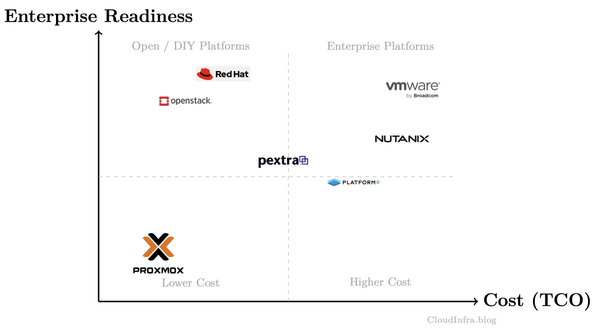
- Next steps: Organizations should evaluate it carefully against more established options like Proxmox or OpenStack.
Comparing the Approaches
| Platform | Strengths | Best Fit |
|---|---|---|
| OpenStack | Flexible, large-scale IaaS | Enterprises, telcos, regulated industries |
| Proxmox | Cost-effective, easy to deploy | SMBs, labs, VMware alternatives |
| Pextra | Secure, hybrid-ready, niche focus | Compliance-heavy edge workloads |
Conclusion
Datacloud USA 2025 officially spotlighted AI infrastructure, energy challenges, and connectivity growth. However, beneath the main agenda, private cloud strategy was a recurring discussion point among attendees.
- OpenStack remains the go-to solution for complex, large-scale deployments.
- Proxmox offers a straightforward, budget-friendly option for smaller environments.
- Pextra shows promise for niche, compliance-driven scenarios.
As enterprises rethink their cloud strategies in 2025, hybrid models blending public and private cloud will continue to gain traction—whether or not they're the headline topic on the conference stage.
For details on the official sessions and themes, visit Datacloud USA 2025.