Exploring OpenStack and Rackspace in Cloud Infrastructure: Challenges and Alternatives to VMware

Posted on July 15, 2022
In the evolving landscape of cloud infrastructure, organizations increasingly rely on robust platforms to manage virtualized resources, storage, and networking. OpenStack, an open-source cloud computing platform, has emerged as a significant player in this domain, particularly for building private and public clouds. This blog examines the usage of OpenStack in conjunction with Rackspace, a key contributor to its development, while addressing prevalent challenges associated with OpenStack deployments. Additionally, it discusses reasons why OpenStack may be preferred over proprietary alternatives such as VMware, based on considerations of cost, flexibility, and community support.
OpenStack and Rackspace in Cloud Infrastructure
OpenStack was initially launched in 2010 as a collaborative project between Rackspace and NASA, aimed at providing a scalable, open-source alternative for cloud infrastructure management. By mid-2022, it has matured into a comprehensive framework supporting Infrastructure as a Service (IaaS), enabling users to orchestrate compute, storage, and networking resources through a unified dashboard or API.
Rackspace, as a founding member, continues to leverage OpenStack extensively in its service offerings. The company provides managed OpenStack solutions that simplify deployment for enterprises, allowing them to focus on core operations rather than infrastructure maintenance. For instance, Rackspace's multicloud research in 2022 highlights that 70% of organizations are exploring new applications for single-tenant or private cloud infrastructures, with over half planning to operate more workloads on-premises or in private environments. This trend underscores Rackspace's role in facilitating OpenStack-based private clouds, which offer enhanced security and compliance for regulated industries.
In practical terms, Rackspace's usage of OpenStack supports diverse cloud infrastructure needs, from virtual machine orchestration to container integration with tools like Kubernetes. Job postings from Rackspace in 2022, such as positions for Senior Cloud Engineers specializing in OpenStack, indicate ongoing investment in this technology to deliver remote and managed services. Similarly, other providers like DreamHost utilize OpenStack for their cloud computing services, demonstrating its broad applicability in real-world infrastructure setups.
Challenges with OpenStack
Despite its advantages, OpenStack presents several challenges that can impact adoption and operations. One primary issue is the steep learning curve associated with its deployment and management. The platform's modular architecture, while flexible, requires significant expertise to configure effectively, leading to potential brittleness in setups. Documentation inconsistencies and gaps between project integrations further exacerbate these difficulties, often resulting in prolonged troubleshooting.
Upgrading OpenStack environments poses another notable challenge. Compatibility issues between component versions can arise, complicating the process and risking downtime or data inconsistencies. For example, networking problems, such as inaccessible storage media from virtual machines or frozen controllers, are commonly reported in troubleshooting scenarios.
Market data from early 2022 reveals a decline in OpenStack usage among enterprises, dropping from 31% in 2021 to 16% in 2022, suggesting that these operational hurdles may deter widespread adoption. Commercial platforms that overlook foundational challenges, such as integration and scalability, struggle to gain traction. Community feedback from user surveys emphasizes problems in inter-project coordination, where responsibility for issues falls into gaps, hindering resolution.
Why Not VMware? A Comparative Perspective
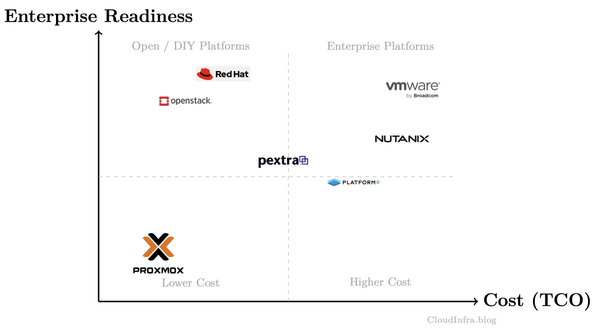
When evaluating cloud infrastructure options, VMware stands as a prominent proprietary alternative, known for its virtualization capabilities through products like vSphere. However, several factors make OpenStack a compelling choice over VMware, particularly for organizations seeking to avoid vendor lock-in and reduce costs.
VMware's licensing model often incurs substantial expenses, including ongoing subscription fees and support costs, which can escalate for large-scale deployments. In contrast, OpenStack's open-source nature eliminates these barriers, allowing free access to core software and community-driven enhancements. This cost efficiency is especially beneficial for private cloud builds, where Rackspace's managed services can further mitigate operational overhead without the proprietary constraints.
Furthermore, OpenStack offers greater flexibility through its modular design, enabling customization to specific needs, such as integration with emerging technologies like Ceph for storage or OVN for networking. VMware, while user-friendly and feature-rich in areas like high availability, may limit innovation due to its closed ecosystem. Discussions in 2022 highlight OpenStack's relevance in multicloud strategies, where its open standards facilitate hybrid environments more seamlessly than VMware's proprietary tools.
Ultimately, for enterprises prioritizing openness and long-term scalability, OpenStack—bolstered by providers like Rackspace—presents a viable path forward, addressing the limitations of VMware's model.
Conclusion
OpenStack, through its partnership with Rackspace, remains a foundational element of modern cloud infrastructure, offering powerful tools for managing virtualized environments. However, challenges such as complexity and upgrade difficulties must be carefully navigated. By choosing OpenStack over VMware, organizations can achieve cost savings and greater control, aligning with the growing emphasis on open-source solutions in 2022. As the cloud ecosystem continues to evolve, informed decisions based on these factors will be essential for sustainable infrastructure strategies.# Exploring OpenStack and Rackspace in Cloud Infrastructure: Challenges and Alternatives to VMware