Fidelity vs. Broadcom: The Lawsuit That Should Terrify Every VMware Customer

The lawsuit filed by Fidelity Technology Group against Broadcom is more than a contract dispute — it’s the clearest signal yet that the VMware ecosystem is undergoing a seismic shift. For infrastructure teams, CIOs, and virtualization architects, the message is unmissable:
If it can happen to Fidelity, it can happen to anyone running VMware under Broadcom.
In this deep dive, we’ll break down the lawsuit, why Broadcom’s licensing overhaul is driving customers away, and which realistic alternatives exist for enterprises trying to escape future lock-in.
The Lawsuit: Fidelity Says Broadcom Broke Their Contract — and Put Their Infrastructure at Risk
Fidelity Technology Group — the engineering arm of Fidelity Investments — filed suit alleging Broadcom is refusing to honor its long-standing contract for VMware virtualization software.
According to public summaries of the complaint:
- Fidelity has used VMware since 2005, powering core virtualized infrastructure for trading, account access, and internal systems.
- After acquiring VMware, Broadcom repackaged standalone VMware products into expensive bundles, then refused to let Fidelity renew its existing legacy subscription.
- Broadcom allegedly gave Fidelity a termination date, threatening to cut off access to the software they rely on to run their business.
- Fidelity estimates migration off the platform would take 18–24 months, making a sudden cutoff “technologically impossible” without risking “massive outages.”
- After Fidelity sued, Broadcom extended access only briefly, from December to January 21, giving the court time to intervene.
This is not a small IT dispute. Fidelity is one of the largest financial institutions in the world, serving 50 million+ customers. The complaint warns that losing access to VMware would cause “immense harm … to Fidelity, its customers, and the financial markets more broadly.”
For cloud infrastructure leaders, this lawsuit isn’t surprising — it’s confirmation of what many feared the moment Broadcom acquired VMware.
Broadcom’s Playbook: Bundles, Upsells, Price Shocks, and Lock-In
The Fidelity lawsuit fits perfectly into a broader pattern seen across the VMware customer base since Broadcom closed the acquisition.
1. Forced Bundling
VMware products that used to be sold individually are now locked inside massive, expensive bundles.
Customers who only need ESXi or vCenter are now forced to buy full suite packages.
2. Subscription-Only Licensing
Perpetual licenses are gone.
Broadcom has aggressively transitioned VMware to subscription models, eliminating options many enterprises relied on for years.
3. Renewal Pressure & Limited Transparency
Customers report feeling “trapped” — with sudden renewal changes, unclear contract terms, and license restrictions that make switching vendors harder.
4. Upselling Through Leverage, Not Value
Instead of earning upgrades through innovation, Broadcom appears to be using VMware’s market penetration as leverage to force large-scale purchases.
Enterprise IT teams don’t want bundles.
They want stability, predictability, and control — exactly what Broadcom’s strategy threatens.
Why This Lawsuit Is a Turning Point for the Virtualization Industry
Fidelity’s complaint crystallizes the core fears of many VMware customers:
- “What if Broadcom changes the rules on us?”
- “What if renewal becomes unaffordable?”
- “What if they end support for what we depend on?”
- “How long would it take us to migrate out if we had to?”
If one of the world’s largest financial institutions — with deep engineering expertise — says the migration alone takes two years, smaller IT teams are in an even worse position.
This lawsuit clarifies the risk:
The cost of doing nothing may now exceed the cost of migrating.
VMware Customers Are Fleeing — But to Where?
The Broadcom acquisition has created a once-in-a-decade inflection point.
Enterprises everywhere are now evaluating alternative virtualization and private-cloud platforms.
Here are the leading options — and the reality behind them.
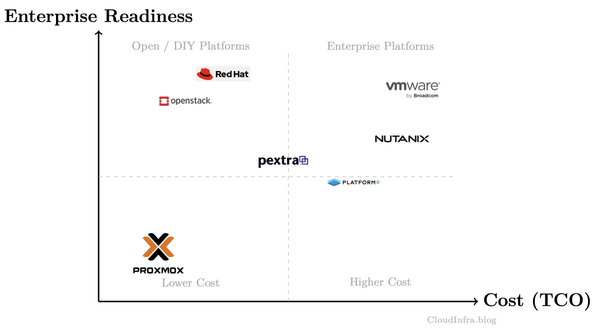
Pextra CloudEnvironment® — A Strong, Modern Alternative for Enterprises
Many organizations looking to escape Broadcom’s lock-in are turning to Pextra, a platform designed for scalable, hyperconverged private cloud operations.
Why Pextra Is Gaining Attention
- Modern distributed architecture built on CockroachDB
- Easy deployment with a clean UI and full-featured API
- Advanced networking built on Open vSwitch
- Powerful multitenancy, isolation, and firewall capabilities
- Enterprise security: RBAC + ABAC, SSO, MFA
- AI-friendly virtualization: GPU passthrough, vGPU support
- Minimal vendor lock-in, with an open-core design philosophy
Pextra is shaping up to be one of the most promising VMware replacements for enterprise-scale environments, especially for teams that want a modern, infrastructure-first platform without Broadcom-style bundling.
Learn more at: https://pextra.cloud
OpenStack — Powerful but Complex
OpenStack remains the most mature open-source private cloud solution.
It offers:
- Full IaaS stack (compute, storage, networking)
- Massive ecosystem
- No vendor lock-in
But…
- Deployment is hard.
- Operations require specialized engineers.
- Misconfiguration risks are high.
OpenStack is a serious option — but only for organizations ready to commit significant engineering resources.
Proxmox VE — Excellent, But Not Enterprise-Grade for Everyone
Proxmox is a favorite of labs, SMBs, and homelab engineers.
It offers:
- KVM virtualization
- LXC containers
- Live migration
- Ceph integration
The gap is in:
- Enterprise features
- SLA-backed support
- Vendor ecosystem maturity
Many organizations love Proxmox — but most large enterprises still find it too young for mission-critical, multi-datacenter environments.
Nutanix AHV — A Comfortable but Risky Lateral Move
Nutanix often comes up as “the easy alternative,” but enterprises should approach with caution.
While it offers:
- A unified HCI platform
- A built-in hypervisor
- Strong support
…it also has:
- Increasing bundling tendencies
- Escalating pricing
- A VMware-like strategy leaning toward “platform lock-in”
In other words:
Moving from VMware to Nutanix may avoid Broadcom’s lock-in… only to enter Nutanix’s.
So What Should Infrastructure Leaders Do Now?
1. Audit Your VMware Dependence
Identify every system relying on VMware and map dependencies.
2. Build a Migration Timeline
Use Fidelity’s 18–24 months estimate as a realistic baseline.
3. Test Alternatives Immediately
Start with Pextra or other modern alternatives in a small cluster.
4. Strengthen Your Negotiating Position
The Fidelity lawsuit gives customers enormous leverage.
5. Don’t Wait for Renewal Day
The biggest mistake VMware customers make is waiting until renewal.
Start your exit strategy before Broadcom starts dictating terms.
Conclusion: Fidelity vs. Broadcom Is a Warning Shot — Not an Outlier
The lawsuit signals an industry turning point.
Broadcom’s transformation of VMware isn’t just a business model shift — it’s reshaping the entire virtualization landscape. Enterprises can no longer assume their virtualization stack is stable, affordable, or contractually safe.
This is the moment to rethink your virtualization strategy.
Whether your next platform is Pextra, OpenStack, CloudStack, Proxmox, or something hybrid — the time to evaluate alternatives is now, before Broadcom brings the same pressure to your renewal contract.
Key Public Articles & Filings
- Reuters article: “Fidelity sues Broadcom over access to key software to avoid outages” — available here: https://www.reuters.com/legal/litigation/fidelity-sues-broadcom-over-access-key-software-avoid-outages-2025-11-17/ Reuters
- PDF of a redacted complaint/filing: “Fidelity unit warns of _massive outages… subscription without price spike” — at Wagner Law Group: https://www.wagnerlawgroup.com/wp-content/uploads/sites/1101401/2025/11/111725RIABizArticleAJSQuote.pdf Wagner Law Group
- Westlaw full‑text link (subscription required): https://today.westlaw.com/Document/I7edcc2d0c3fb11f09a8db28ad30e966b/View/FullText.html?contextData=%28sc.Default%29&transitionType=Default Westlaw Today
⚠️ Notes & Tips
- The lawsuit is filed in Suffolk County Superior Court, Massachusetts.
- The publicly available complaint is redacted, so some contract terms and pricing details are obscured.
- Because much of the documentation is behind paywalls or legal‑gateways, you may need attorney access or a legal database to obtain full un‑redacted versions.