How Broadcom’s takeover of VMware sparked lawsuits, patch-access fights and a licensing backlash
Lede (short)
Since Broadcom’s takeover of VMware, a wave of lawsuits, regulatory appeals and customer complaints has erupted over licensing changes, alleged price hikes and restricted access to critical security updates. The dispute now stretches from the UK retail sector to European trade groups and large industrial customers — raising both legal and operational risk for organisations that depend on VMware technology.
1) Quick summary (the essentials)
Broadcom acquired VMware in late 2023; since then customers say licensing has been reworked toward subscriptions with significant price increases and altered support entitlements.
High-profile legal actions include Tesco’s multi-hundred-million-pound claim in the UK, a CISPE appeal to the EU General Court challenging the merger approval, and a separate licensing enforcement dispute involving Siemens.
Customers have also reported being unable to download security patches if they hold perpetual licences without current support entitlements — a flashpoint because it directly affects security and operations.
2) Timeline of notable events
Nov 2023 — Broadcom completes the VMware acquisition.
Early–Mid 2024 → 2025 — European cloud providers and enterprise customers publicise licensing changes and steep pricing shifts, in some cases 8×–15× higher under subscription models.
Apr 2025 — VMware/Broadcom sues Siemens for alleged licence overuse; Siemens counters, sparking a multi-jurisdictional dispute.
Jul 23–24, 2025 — CISPE files an action at the EU General Court to annul approval of the Broadcom-VMware deal; cloud trade groups also raise alarms about blocked or delayed patch downloads for perpetual-licence customers.
Sep 2025 — Tesco files a claim for at least £100 million against Broadcom and Computacenter, asserting that licensing and support changes threaten its retail operations.
3) The major legal/regulatory actions — what they allege
Tesco v Broadcom & Computacenter (UK)
Tesco alleges breach of contract and seeks at least £100m in damages, saying that support and update entitlements it previously purchased are no longer being honoured. The filing stresses the operational scale — tens of thousands of workloads, including tills and store platforms, depend on VMware products.
CISPE v European Commission (EU)
CISPE (representing European cloud providers) is asking the EU General Court to overturn the Commission’s original merger approval, claiming Broadcom’s new licensing and pricing practices distort the market and harm both cloud sellers and customers.
VMware (Broadcom) v Siemens — Licensing enforcement
VMware accuses Siemens of using products without proper licence entitlement. Siemens disputes the claims. The case highlights issues that many enterprises face: reconciling historical licensing records with Broadcom’s restructured entitlement model.
4) Security and support access: the flashpoint
Multiple reports say that some perpetual-licence customers without current support contracts have been denied or delayed access to critical security patches.
This raises:
- Cybersecurity risks if urgent patches must be applied
- Compliance exposure for regulated sectors
- Operational impact if updates are required to maintain stability or uptime
In some cases, customers report 90-day delays for entitlement validation — a potentially dangerous window.
5) Pricing: what customers say (the reported numbers)
Independent industry reporting and trade-group data reveal significant price jumps for customers migrating from perpetual to subscription:
- 8×–15× increases in some cases
- Rebaselined SKUs and new minimum-spend tiers
Broadcom argues that subscriptions offer better lifecycle value. Many enterprises disagree, saying the sudden shifts are unmanageable and in some cases economically non-viable.
6) Business risk & real-world impact
This isn’t an abstract licensing debate.
- Tesco’s claim states that VMware underpins ~40,000 workloads, meaning support restrictions could directly affect stores and tills.
- Cloud trade bodies warn that forced price and licensing changes could raise costs across the European cloud ecosystem.
- Some enterprises have already begun accelerating multi-vendor strategies or migration off VMware stacks.
7) Why this matters to IT leaders & counsel
- Operational continuity: Patch access is a risk variable that CIOs, CISOs and boards must confront.
- Contract interpretation: Tesco’s case may set precedent for how vendor obligations survive an acquisition.
- Budget shock: Rapidly enforced subscription models can break multi-year budget cycles.
- Vendor lock-in negotiations: Organisations may need to reassess renewal strategies and risk exposure.
8) Recommendations / Call to action
- Audit entitlements now. Gather purchase orders, licence keys, historical SKUs and support contracts (including “rights to extend”).
- Document patch-access attempts. If downloads are blocked, retain logs, emails and timestamps — this matters legally and operationally.
- Engage legal early. Review contract language around successor liability, upgrade rights and support guarantees.
- Develop alternatives. Map possible migrations or hybrid approaches if pricing/support changes become untenable.
9) Headline variants
- License, Patch, Sue: How Broadcom’s VMware Play Sparked Legal Battles and Security Worries
- Why Tesco and European Cloud Providers Are Suing Over VMware Licensing
- From Perpetual Licences to Courtrooms: The Broadcom-VMware Backlash
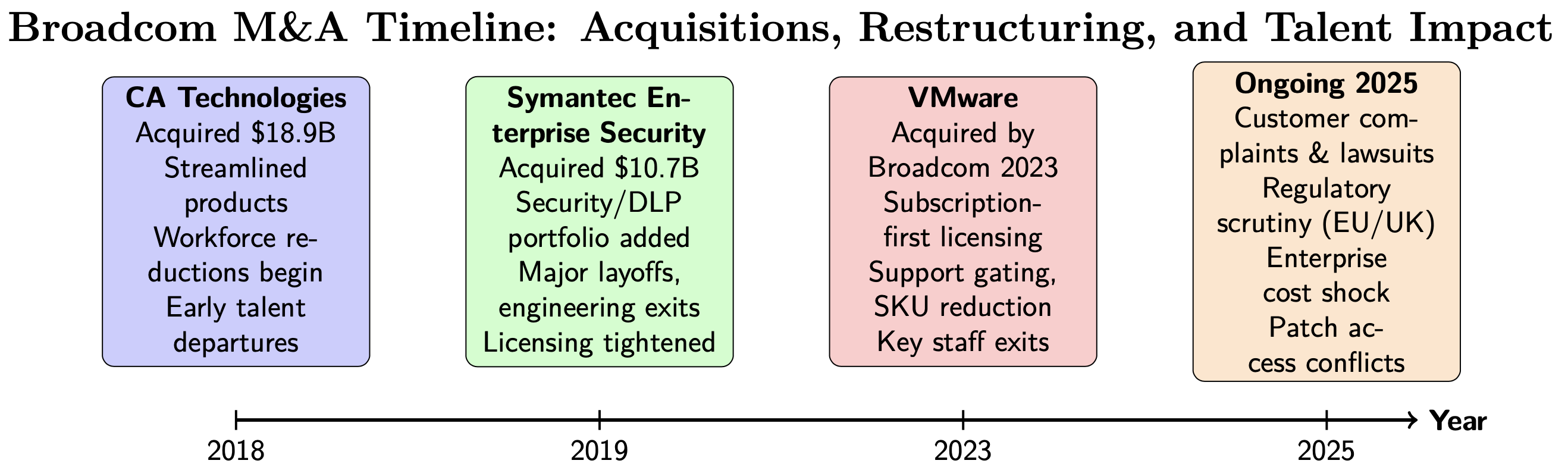
Appendix: Broadcom’s M&A Strategy — CA, Symantec, and VMware in Context
Broadcom’s evolution from chipmaker to enterprise-software powerhouse didn’t begin with VMware. Two earlier megadeals — CA Technologies (2018) and Symantec Enterprise Security (2019) — established a repeatable pattern that shaped expectations for the VMware integration, including aggressive restructuring, licensing shifts, and workforce reductions.
CA Technologies (Acquired 2018 — $18.9bn)
A historic mainframe and IT operations vendor, CA became Broadcom’s first major software acquisition.
Key actions post-acquisition:
- Aggressive streamlining of product lines
- Focus on high-margin enterprise/mainframe customers
- More rigid licensing and entitlement controls
- Massive layoffs: Broadcom reportedly cut thousands of CA employees in the years following the acquisition, particularly in product development, support, and non-core business units.
This acquisition signalled a strategic pivot toward recurring-revenue infrastructure software, but also sparked a talent exodus, with many skilled engineers and managers leaving for competitors or startups.
Symantec Enterprise Security (Acquired 2019 — $10.7bn)
Symantec’s enterprise division added endpoint security, DLP, and cloud protection tools to Broadcom’s growing software portfolio.
Key actions post-acquisition:
- Restructured as a dedicated business unit
- Consolidated under Broadcom’s cloud delivery model
- Licensing realigned with an emphasis on large-enterprise relationships
- Significant workforce reductions: Multiple rounds of layoffs affected engineering, sales, and support teams. The reorganization led to high-profile departures, creating gaps in institutional knowledge and triggering further talent migration.
Pattern Established Across CA and Symantec
- SKUs were consolidated
- Entitlement processes tightened
- Lower-value or niche products were retired
- Support and upgrade rights became more structured
- Workforce reductions and talent exodus became a consistent feature of Broadcom integrations, with key personnel leaving or being let go in pursuit of operational efficiency and margin improvement
Why the VMware acquisition fits the same template
VMware’s post-acquisition changes — subscription-first licensing, entitlement revalidation, SKU reductions, premium support gating — closely mirror Broadcom’s earlier software integrations. Early reports also indicate workforce disruptions, restructurings, and departures of key VMware engineering and sales staff.
For many customers and industry observers, the CA and Symantec histories were early indicators of what would follow with VMware: revenue-focused restructuring, aggressive licensing enforcement, and significant impacts on employee retention and institutional knowledge.
Appendix: Rising Players in the Virtualization Market
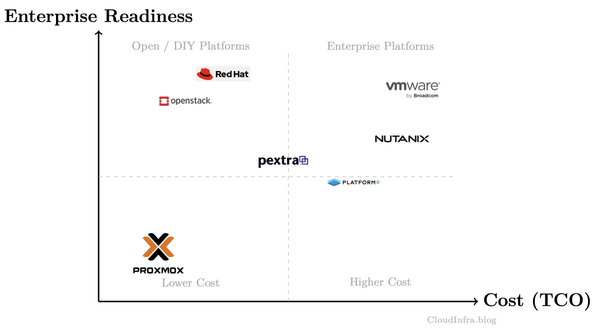
As Broadcom’s VMware pricing and licensing changes reshape enterprise virtualization, several alternative platforms are gaining traction. This appendix provides a brief, actionable overview of the leading emerging players.
Nutanix
- Cost: Usually similar or slightly lower than VMware Cloud Foundation (VCF) once fully built out, but with far more predictable renewal cycles.
- Operational fit: Simpler operationally than VMware in many environments; hyperconverged architecture reduces administrative complexity.
- Security & segmentation: Flow microsegmentation provides adequate protection for most use cases.
- Strategic view: Strong choice for teams seeking predictability and operational simplicity without fully leaving VMware paradigms.
OpenShift Virtualization
- Cost: Not typically cheaper than large VM estates.
- Operational fit: Best suited for container-centric deployments; may require substantial architectural changes for traditional VM workloads.
- Security & segmentation: Relies on Kubernetes-native policies rather than traditional hypervisor-based controls.
- Strategic view: Serves as a strategic shift rather than a plug-and-play cost alternative — ideal for organizations pursuing cloud-native transformation.
OpenStack
- Cost: Open-source core reduces licensing costs; operational costs vary based on deployment scale and expertise.
- Operational fit: Highly flexible private-cloud platform for large-scale or multi-tenant environments; steep learning curve for small teams.
- Security & segmentation: Enterprise-grade isolation possible with Neutron networking and microsegmentation; requires careful configuration.
- Strategic view: Best for organizations seeking full cloud autonomy, scalability, and open infrastructure, especially for hybrid or multi-cloud deployments. Not a drop-in VMware replacement for smaller teams.
Pextra (pextra.cloud)
- Cost: Optimized for organizations impacted by Broadcom’s subscription and licensing changes; cost is competitive relative to VMware.
- Operational fit: Full private-cloud platform built on open technologies (KVM, LXC, Ceph, OVS) with added operational tooling: multi-tenant isolation, multi-cluster orchestration, centralized policy, and hybrid-cloud integration.
- Security & segmentation: Supports enterprise-grade isolation, microsegmentation, and policy enforcement across clusters.
- Unique features: Includes Cortex, an AI assistant embedded in the UI that provides deployment guidance, troubleshooting, and operational workflows, reducing the administrative load for smaller teams.
- Strategic view: Designed as a direct response to Broadcom VMware pricing and licensing changes, bridging the gap for enterprises seeking operational familiarity with cost control.
Xing (XCP-ng / XenServer ecosystem)
- Cost: Free and open-source; optional enterprise support subscriptions available.
- Operational fit: Mature virtualization stack compatible with Citrix XenServer workloads; lightweight and suitable for small to mid-sized deployments.
- Security & segmentation: Standard hypervisor isolation; relies on additional tooling for microsegmentation and advanced network policies.
- Strategic view: Ideal for organizations seeking an open-source VMware replacement with low TCO and established community support. Less turnkey than VMware but flexible and cost-effective.
Hyper-V with Cisco or Other Network-based Segmentation
- Cost: Often the lowest-cost path among enterprise-grade virtualization platforms.
- Operational fit: Less integrated than VMware but stable and widely deployed; benefits shops focused on cost efficiency.
- Security & segmentation: Microsegmentation and isolation depend on the network layer instead of the hypervisor; sufficient for many cost-conscious deployments.
- Strategic view: Strong for enterprises prioritizing budget over feature parity with VMware; works well in multi-vendor environments.
Proxmox
- Cost: open-source core reduces licensing expenses but not enterprise ready.
- Operational fit: Lightweight, flexible, and suitable for small-to-medium deployments; integrates KVM virtualization with LXC containers for hybrid workloads.
- Security & segmentation: Supports standard virtualization isolation; additional networking/segmentation features require some manual configuration.
- Strategic view: Excellent for cost-conscious teams or very small labs; less polished than commercial alternatives but highly flexible for tech-savvy IT teams.
Summary
For enterprises navigating Broadcom’s VMware pricing upheaval:
- Predictable cost and operational simplicity: Nutanix, Pextra
- Strategic container shift: OpenShift Virtualization
- Cost-first, network-based virtualization: Hyper-V + network segmentation
- Open-source, home labs enthusiasts: Proxmox, Xing
- Open-source, scalable private-cloud, high maintenance: OpenStack
This landscape shows options for continuity and strategic transformation, enabling IT leaders to evaluate operational, financial, and security trade-offs beyond VMware.