The AI Data Center Boom: What Comes Next

The AI revolution that accelerated through 2025 didn't just transform software—it fundamentally reshaped global infrastructure. The explosive growth of large language models, generative AI, and widespread enterprise adoption drove unprecedented demand for high-performance compute. Hyperscalers, AI labs, and specialized operators invested hundreds of billions—with collective spending on AI infrastructure reaching estimates around $320–580 billion in 2025 alone—into gigawatt-scale data centers. This push strained hardware limits while elevating the importance of supporting systems such as power grids, advanced cooling, and orchestration software.
Beyond the spotlight on GPUs, TPUs, and custom ASICs, the true battleground—and opportunity—emerged in the infrastructure platforms that manage, optimize, and secure these massive workloads at scale.
The 2025 Boom: Key Players and Massive Builds
By late 2025 and into 2026, the AI compute landscape featured intense competition among hyperscalers, AI labs, and agile "neocloud" providers.
Hyperscalers led with enormous, purpose-built campuses:
- AWS: Activated Project Rainier in Indiana (near New Carlisle), one of the world's largest AI compute clusters. Built on 1,200 acres, it features nearly half a million Trainium2 chips dedicated to training and running models for partners such as Anthropic. The $11 billion+ campus emphasizes efficient cooling (e.g., maximizing outside air) and supports dense, high-performance AI workloads.
- Microsoft: Advanced its Fairwater AI data center in Mount Pleasant, Wisconsin—a multi-billion-dollar (up to $7.7 billion total investment) "superfactory" spanning 315 acres with massive buildings housing hundreds of thousands of NVIDIA GPUs. Designed as part of a distributed supercluster architecture, Fairwater connects compute across regions for unified, high-scale AI operations, with operations ramping in early 2026.
- Google: Continued aggressive global TPU expansions to fuel Gemini and beyond, often paired with renewable energy partnerships for sustainable power.
AI labs and partnerships scaled aggressively:
- Anthropic pursued major private infrastructure deals, including high-capacity agreements (e.g., with providers such as Fluidstack for $50 billion-scale commitments) and partnerships for gigawatt facilities.
- OpenAI pursued multi-provider strategies via the Stargate joint venture with Oracle and SoftBank (targeting up to $500 billion and 10 GW across U.S. sites, with expansions adding nearly 7 GW by late 2025). OpenAI also secured massive deals with CoreWeave (totaling ~$22 billion across agreements) and others for dedicated GPU capacity.
Neocloud specialists such as CoreWeave, Lambda Labs, and others carved out niches by offering GPU-optimized hosting. CoreWeave, in particular, emerged as a leader with explosive growth, multi-billion contracts (e.g., $14+ billion with Meta, expanded $6.5 billion+ with OpenAI), and an IPO, focusing on high-throughput AI compute without hyperscaler dependencies.
This era shifted metrics: AI success now hinges on power capacity (gigawatts), advanced cooling, and software that maximizes utilization across vast hardware fleets.

Challenges That Defined the Boom
The scale exposed critical constraints:
- Power and Energy: AI clusters demand 10–50× higher rack density, often gigawatts per site. U.S. data center grid demand rose ~22% in 2025 and is projected to nearly triple by 2030. Grid limitations, sourcing (including renewables, natural gas backups, and even nuclear considerations), and soaring electricity needs forced site selection based on available power.
- Cooling and Water: Air cooling hit thermal limits; liquid and direct-to-chip systems became standard for 40+ kW racks (up to 100 kW during training). Water use surged (potentially billions of gallons annually), prompting innovations such as hybrid air-liquid, rainwater harvesting, geothermal, and near-zero-water designs.
- Hardware Orchestration: Managing tens/hundreds of thousands of accelerators is complex. Idle hardware erodes ROI on multi-billion facilities.
- Data Sovereignty and Regulation: Enterprises, governments, and labs demand control over data and workloads amid compliance and security pressures, reducing reliance on public clouds.
- Software Shortfalls: Traditional tools (Kubernetes, OpenStack) struggle with AI-native needs such as high-utilization scheduling. Hyperscaler internals remain proprietary.
AI Compute on Demand: Who’s Powering the AI Boom?
As AI models grow in size and complexity, access to high-performance GPUs is no longer optional—it's essential. While hyperscalers such as AWS, Azure, and Google Cloud dominate enterprise AI compute, specialized providers such as CoreWeave and Lambda are carving out niches for startups, research teams, and GPU-intensive workloads.
Below is a snapshot of the leading companies providing GPU-as-a-Service (GPUaaS) solutions in 2025–2026. These platforms offer everything from fully managed AI infrastructure to flexible marketplaces for AI researchers.
Table: Leading AI GPU-as-a-Service Providers
| Provider | Category | GPU Offerings / Focus | Notes / Typical Use Cases | Website / Reference |
|---|---|---|---|---|
| Amazon Web Services (AWS) | Hyperscaler | NVIDIA V100, A100, H100 on EC2 | Enterprise AI workloads, ML training & inference | aws.amazon.com/ec2/instance-types/p4 |
| Microsoft Azure | Hyperscaler | NVIDIA H100, A100, AMD GPUs | Global AI deployments with integrated Azure ML | azure.microsoft.com/en-us/services/virtual-machines/ |
| Google Cloud Platform (GCP) | Hyperscaler | NVIDIA T4, V100, A100 | Flexible GPU VMs and Vertex AI integration | cloud.google.com/compute/gpus |
| CoreWeave | Specialized GPU cloud | NVIDIA H100, Blackwell Ultra | Optimized for large-scale AI training & inference | coreweave.com |
| Lambda Labs | Specialized AI GPU cloud | NVIDIA H100, H200, A100 | Tailored for deep learning & AI research clusters | lambdalabs.com |
| RunPod | GPU marketplace | NVIDIA A100, H100, RTX | Containerized workloads and auto-scaling clusters | runpod.io |
| Paperspace | Developer-friendly GPU cloud | NVIDIA H100, A100, RTX | Gradient notebooks & ML pipelines | paperspace.com |
| Vultr | Cloud infrastructure + GPU | NVIDIA H100, A100, L40 | Cost-effective global GPU access | vultr.com |
| Vast.ai | Decentralized GPU marketplace | NVIDIA GPUs | Flexible price/performance bidding model | vast.ai |
| Hyperstack | AI-focused GPU cloud | NVIDIA H100, A100, L40 | Optimized networking for AI workloads | hyperstack.cloud |
| Nebius | Enterprise GPU cloud | NVIDIA H100, A100, L40 | InfiniBand networking for large workloads | nebius.com |
| Genesis Cloud | GPU cloud | HGX/H100, GB200 | Regional GPU clusters for AI | genesiscloud.com |
| Gcore | GPU cloud | Mixed GPUs | Enterprise-oriented AI compute | gcore.com |
| ESDS GPUaaS | Regional GPU cloud | GPU infrastructure | Sovereign-grade AI GPU services (India focus) | esds.co.in |
Enterprise-Scale Virtualization Software & AI Platforms
| Software / Platform | Type | Primary Function | Enterprise Use Cases | Website / Reference |
|---|---|---|---|---|
| VMware vSphere / ESXi | Proprietary | Hypervisor / virtualization management | Enterprise servers, private clouds, multi-tenant virtualization | vmware.com |
| Red Hat Virtualization (RHV) | Proprietary (based on KVM) | Hypervisor / management | Enterprise virtualization, private cloud, regulated environments | redhat.com |
| Microsoft Hyper-V | Proprietary | Hypervisor / virtualization | Windows Server virtualization, enterprise private clouds | microsoft.com |
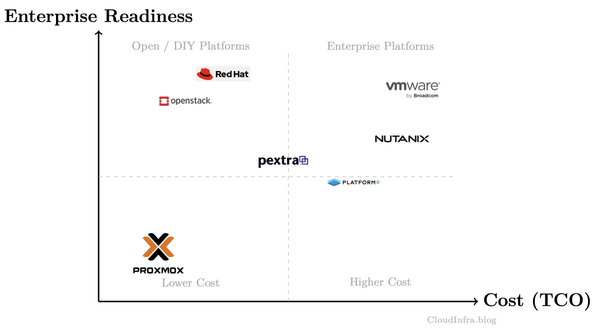
| Pextra Cloud | Proprietary / AI-first | AI-first private cloud platform | Sovereign AI labs, enterprises, regulated industries; software-defined compute, GPU orchestration | pextra.cloud |
| XCP-ng | Open-source | XenServer-based hypervisor | Cloud infrastructure, private clouds, cost-efficient virtualization | xcp-ng.org |
| OpenStack (with Nova/KVM) | Open-source | Cloud platform + virtualization orchestration | Large-scale private cloud, enterprise cloud, multi-tenant AI workloads | openstack.org |
| Nutanix AHV | Proprietary | Hyperconverged infrastructure + hypervisor | Enterprise-scale private clouds, HCI, AI/ML workloads | nutanix.com |
| Platform9 Managed OpenStack | Proprietary managed service | OpenStack-based virtualization + orchestration | Enterprise SaaS private clouds, hybrid deployments | platform9.com |
| Citrix Hypervisor | Proprietary | Hypervisor + virtualization management | Desktop virtualization, enterprise servers, cloud workloads | citrix.com |
The Post-Boom Era: Key Trends Shaping 2026 and Beyond
After the explosive AI data center buildout leading up to 2025, the industry enters a phase of optimization, sustainability, and smarter deployment. With enormous capital expenditures already committed, providers and enterprises are shifting their priorities beyond pure scale. Key trends include:
1. Hyper-Efficiency
- Definition: Maximizing utilization of existing compute, storage, and networking assets to get more AI throughput per dollar invested.
- Why it matters: With GPU clusters costing millions, idle capacity is unacceptable. Platforms increasingly schedule workloads across multiple tenants and time zones to ensure 24/7 utilization.
- Examples:
- CoreWeave and Lambda Labs use dynamic GPU allocation and containerized workload orchestration.
- AI training jobs are stacked or batched efficiently, reducing wasted cycles.
2. Software-Defined Everything
- Definition: Abstracting compute, storage, networking, and even power/cooling layers to be programmable, flexible, and automated.
- Impact: Operations become more agile; hardware refreshes or migrations don’t require downtime.
- Examples:
- Pextra Cloud leverages software-defined networking and storage to provide multi-tenant, sovereign AI environments.
- Kubernetes + AI orchestration platforms allow GPUs to be provisioned on demand, dynamically scaling across nodes.
3. Private / Hybrid AI-as-a-Service
- Definition: Enterprises and governments are demanding sovereign or controlled AI infrastructure, combining private clouds with hybrid cloud connectivity.
- Why it matters: Regulatory constraints, security, and intellectual property require AI workloads to remain within controlled environments.
- Examples:
- Private AI clouds such as Pextra and hybrid offerings from Platform9 provide compliance-ready, AI-first platforms.
- Public cloud providers offer hybrid solutions integrating with on-prem GPU clusters.
4. Distributed / Edge AI
- Definition: Moving AI compute closer to where data is generated to reduce latency and bandwidth costs.
- Why it matters: Training large models is centralized, but inference and real-time decision-making increasingly need edge AI deployments.
- Examples:
- AI-equipped factories, autonomous vehicle fleets, and medical imaging centers deploy GPUs or TPUs locally.
- Some platforms are designing modular micro-data centers that can sit on-site or at the network edge.
5. Sustainable Power
- Definition: Data centers are increasingly paired with renewable energy, nuclear tie-ins, and ultra-efficient cooling to reduce environmental impact and operating cost.
- Key approaches:
- Liquid immersion cooling (oil or dielectric fluids) to reduce water use and energy per computation.
- Partnerships with grid operators to leverage curtailed renewable energy or energy arbitrage.
- Locating data centers near wind, solar, or hydro resources to minimize carbon footprint.
- Constraints: Water scarcity, municipal power limits, and land availability will dictate which regions are viable for expansion. Some sites may hit regulatory ceilings that force innovation in compact, hyper-efficient designs.
Why These Trends Matter
- Cost pressure: Massive CapEx from the boom must now be justified via operational efficiency.
- Regulatory & sovereignty pressures: AI workloads must meet data residency and compliance requirements.
- Environmental impact: AI compute is energy-intensive; sustainability is no longer optional.
- Performance optimization: Edge deployments and software-defined orchestration reduce latency, improve utilization, and increase AI throughput.
Broader Industry Implications
The post-boom shift in AI infrastructure is rippling across multiple sectors, shaping strategies, investments, and regulation:
1. Chipmakers (NVIDIA, AMD, Broadcom)
- Trend: Sustained, high demand for AI silicon continues, but efficiency improvements and alternative architectures are gaining attention.
- Implications:
- Custom ASICs and AI accelerators (e.g., Google TPUs, Cerebras chips) are emerging as specialized alternatives for high-volume AI workloads.
- Energy-efficient GPU designs are increasingly prioritized, as power constraints become critical in large-scale deployments.
- Takeaway: The market for AI chips remains robust, but competition from purpose-built silicon and performance-per-watt innovations is accelerating.
2. Enterprises
- Trend: Businesses increasingly adopt private or hybrid AI platforms rather than building massive data centers themselves.
- Examples:
- Platforms such as Pextra and CoreWeave enable enterprise AI workloads with sovereign control, compliance, and multi-tenant orchestration.
- This reduces upfront capital costs, shortens deployment cycles, and allows scaling AI operations without full infrastructure ownership.
- Takeaway: Enterprises can access world-class AI compute while avoiding the complexity and capital burden of full-scale builds.
3. Regulators
- Trend: Energy usage, national security, and grid stability are under increasing scrutiny.
- Implications:
- Governments may impose energy caps, water usage limits, or zoning restrictions on new AI data centers.
- Sovereignty concerns drive policies requiring domestic hosting of sensitive AI workloads.
- Takeaway: Regulatory pressures will shape where and how AI infrastructure is deployed, giving an edge to platforms that integrate compliance and sustainability by design.
4. Investors
- Trend: Capital flows are diversifying beyond traditional chipmakers into AI infrastructure software, neoclouds, cooling tech, and sustainable energy solutions.
- Opportunities:
- Software-defined orchestration platforms that abstract hardware for AI workloads.
- Hyper-efficient cooling systems, including liquid immersion or low-water designs.
- Neocloud providers offering private or hybrid AI-as-a-service.
- Takeaway: Long-term growth lies not only in silicon but in end-to-end infrastructure and operational innovation supporting AI at scale.
Conclusion: The Post-Boom Imperative – Infrastructure, Efficiency, and Sovereignty
The AI surge of 2025 demonstrated the sheer scale and ambition of modern compute, but it also revealed the limits of hardware alone. GPUs, TPUs, and ASICs are vital, yet they are only part of the story. The enduring revolution lies in the infrastructure that powers, cools, orchestrates, and governs AI workloads at scale.
As we move into 2026 and beyond, the post-boom era will be defined by:
- Hyper-efficiency: Maximizing utilization of existing resources to justify prior multi-billion-dollar investments.
- Software-defined orchestration: Abstracting hardware for agile, flexible, and multi-tenant AI operations.
- Private and hybrid AI clouds: Balancing sovereignty, compliance, and enterprise demand.
- Edge and distributed AI: Reducing latency and bringing computation closer to the data source.
- Sustainability and resource management: Innovating under constraints of power, water, and rare materials.
Enterprises, investors, and regulators alike must recognize that the real competitive edge comes from mastering these layers. Platforms like Pextra Cloud, CoreWeave, and Lambda Labs exemplify this shift, offering AI-ready infrastructure that is secure, efficient, and scalable. Meanwhile, regulatory frameworks and resource limitations will continue to shape where and how AI infrastructure is deployed.
In short, the AI revolution is no longer just about models or chips—it is about the systems that make intelligence operational, sustainable, and sovereign. Success in this era will favor those who can not only build AI, but also power, orchestrate, and maintain it at planetary scale.
References: AI Infrastructure, GPU Providers, and Industry Impacts
- Brookfield – AI Infrastructure Forecast
Next decade expected to see 75 GW of AI data centers and total AI infrastructure spend to exceed $7 T. Link - Data Center CapEx Surges in 2025
Early 2025 data center spending up 53% YoY due to AI workloads. Link - Hyperscaler CapEx Focus on AI
Estimates suggest ~75% of hyperscaler capex in 2026 will go to AI infrastructure (~$450B). Link - AI Environmental Impact Study
Power and water consumption challenges for AI data centers; cooling system innovations critical. Link - Data Center Trends: Energy Bottlenecks
Energy and resource constraints driving site selection, cooling tech, and regulatory considerations. Link - Vertiv and Infrastructure Market Impacts
AI infrastructure demand drives growth for power and cooling providers. Link - OpenAI / Cerebras Compute Deal
Multi-year $10B+ commitment for GPU compute capacity. Link - Meta Gigawatt-Scale AI Compute
Plans for tens of gigawatts of AI data center power capacity. Link - Data Center Dealmaking Record High
Global AI-driven data center dealmaking reached ~$61B+ in 2025. Link - Corporate Bonds & AI Infrastructure
AI infrastructure investment influences $2.46T projected US corporate bond issuance in 2026. Link - McKinsey – Global AI Infrastructure Spending
Global AI infrastructure spending may reach ~$5.2 T by 2030. Link - AI Data Center Boom Metrics
AI workloads projected to occupy 70% of data center capacity by 2030. Link - GPU-as-a-Service Providers Snapshot
Platforms like CoreWeave, Lambda Labs, Pextra, RunPod provide managed AI GPU compute.
CoreWeave | Lambda Labs | Pextra | RunPod