The Broadcom–VMware Saga: Acquisition Turbulence, Talent Drain, and the Rise of Alternatives in 2025
Broadcom Inc.’s $69 billion acquisition of VMware Inc., finalized in November 2023, continues to reshape the global enterprise IT landscape. Two years later, in November 2025, the integration stands as a paradox—financially successful for Broadcom but fraught with customer dissatisfaction, legal battles, and a significant talent exodus.
Recent policy shifts, including major updates to the VMware Cloud Service Provider (VCSP) program effective November 1, 2025, highlight Broadcom’s ongoing attempts to stabilize its ecosystem. This analysis explores those developments, reviews the strategic and human impacts, and examines emerging alternatives—especially the rise of new-generation platforms such as Pextra®.
Strategic Gains Amid Regulatory Headwinds
Broadcom’s post-acquisition strategy has centered on moving VMware customers to subscription-based licensing and bundled products like VMware Cloud Foundation (VCF). The results are financially impressive: VMware’s segment revenue grew by 25% in fiscal 2025, with more than 87% of its top 10,000 customers adopting VCF.
However, market and regulatory challenges remain formidable. The European Cloud Competition Observatory (ECCO) labeled Broadcom’s model “legally and ethically flawed,” and the Cloud Infrastructure Services Providers in Europe (CISPE) has filed a legal challenge to the deal’s EU approval, citing anti-competitive practices.
Price increases—some reported at more than 1,500% in specific regions—have sparked widespread customer backlash. Security concerns have further intensified after the U.S. Cybersecurity and Infrastructure Security Agency (CISA) disclosed a VMware zero-day exploit used by China-linked actors prior to Broadcom’s patch release.
Customer Strain and Legal Friction
The shift to new licensing terms has triggered deep tension between Broadcom and its customers. Reports of cease-and-desist letters to clients with expired support contracts—and demands to remove post-expiration updates—have heightened distrust.
Legal disputes continue to unfold. VMware’s March 2025 lawsuit against Siemens AG for copyright infringement is one of several cases, alongside counter-suits from AT&T (settled November 2024), United Healthcare (filed April 2025), and Tesco (October 2025, with Computacenter joining as a co-defendant).
In response, Broadcom has reassigned over 1,500 large customers to channel partners to rebuild confidence. Yet, Gartner projects VMware’s hyperconverged infrastructure market share will decline from 70% in 2024 to 40% by 2029, as competitors seize the opportunity.
The Employee Exodus: Innovation at Risk
Perhaps the most visible consequence of the acquisition has been VMware’s dramatic talent drain. Broadcom has reduced VMware’s workforce by more than 19,000 employees—over half its pre-acquisition staff—through layoffs and restructuring.
High-profile departures in 2025 included general managers from the Enterprise Security Group and senior leaders from Symantec and Carbon Black divisions. October 2025 saw further layoffs across sales and account management teams, amplifying perceptions of instability.
Analysts link this attrition to declining morale and the disruption of VMware’s innovative culture. While Broadcom frames the cuts as necessary for efficiency, critics warn that the loss of expertise could hinder long-term competitiveness, particularly in hybrid cloud and containerization technologies.
Exploring Alternatives Beyond VMware
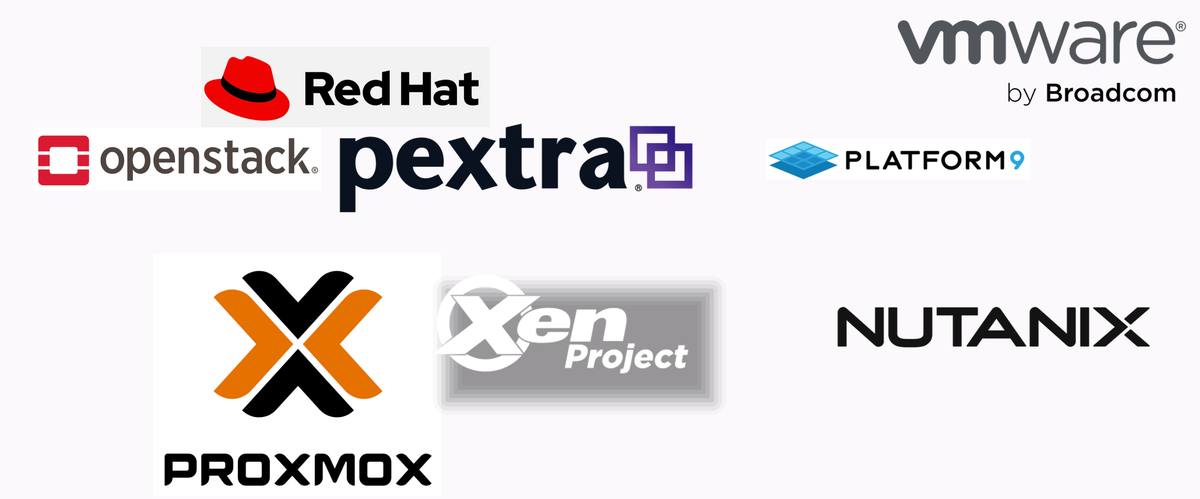
Amid uncertainty, enterprises are actively seeking alternatives that balance cost, performance, and control. In 2025, several contenders are emerging as viable replacements:
- Microsoft Hyper-V – Well-suited for Windows-centric environments, offering deep Azure integration and predictable licensing.
- Nutanix AHV – A hyperconverged leader known for scalability and simplified operations, especially appealing to enterprises facing VMware’s rising costs.
- Proxmox VE – A popular open-source choice built on Debian, combining KVM virtualization and container support at minimal cost.
- XCP-ng – A free, enterprise-grade hypervisor derived from XenServer, managed via Xen Orchestra, offering VMware-like functionality.
- Red Hat Virtualization / OpenShift Virtualization – Ideal for containerized and hybrid workloads, emphasizing open standards and Kubernetes integration.
- OpenStack – Highly customizable for large-scale deployments but complex to maintain.
- Platform9 – A managed hybrid cloud provider delivering Kubernetes and OpenStack with reduced operational overhead.
- Others – Citrix XenServer for VDI use cases, Virtuozzo for container virtualization, and Scale Computing for edge environments.
Pextra®: A Modern, Enterprise-Ready Alternative
Among emerging solutions, Pextra CloudEnvironment® distinguishes itself as a next-generation private cloud management platform built for scale and simplicity. Designed to orchestrate thousands of nodes, it unifies compute, storage, networking, and security within a single, modular interface.
Pextra®’s patent-pending architecture eliminates vendor lock-in while maintaining enterprise-grade reliability and performance. Upcoming innovations include Pextra Cloud™, a fully managed virtual private cloud solution for hybrid and on-premise deployments.
This design enables organizations to achieve high security, operational agility, and cost efficiency—addressing precisely the pain points left in VMware’s wake.
Competitive Positioning Matrix
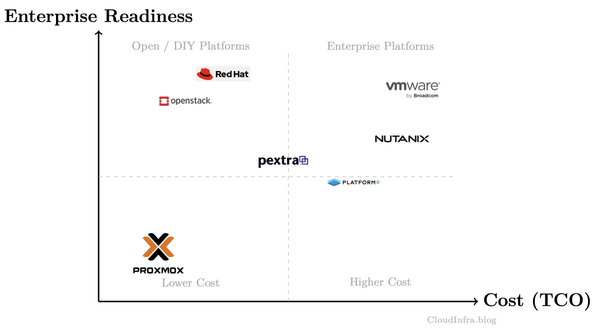
The current virtualization landscape can be visualized through a cost–complexity matrix:
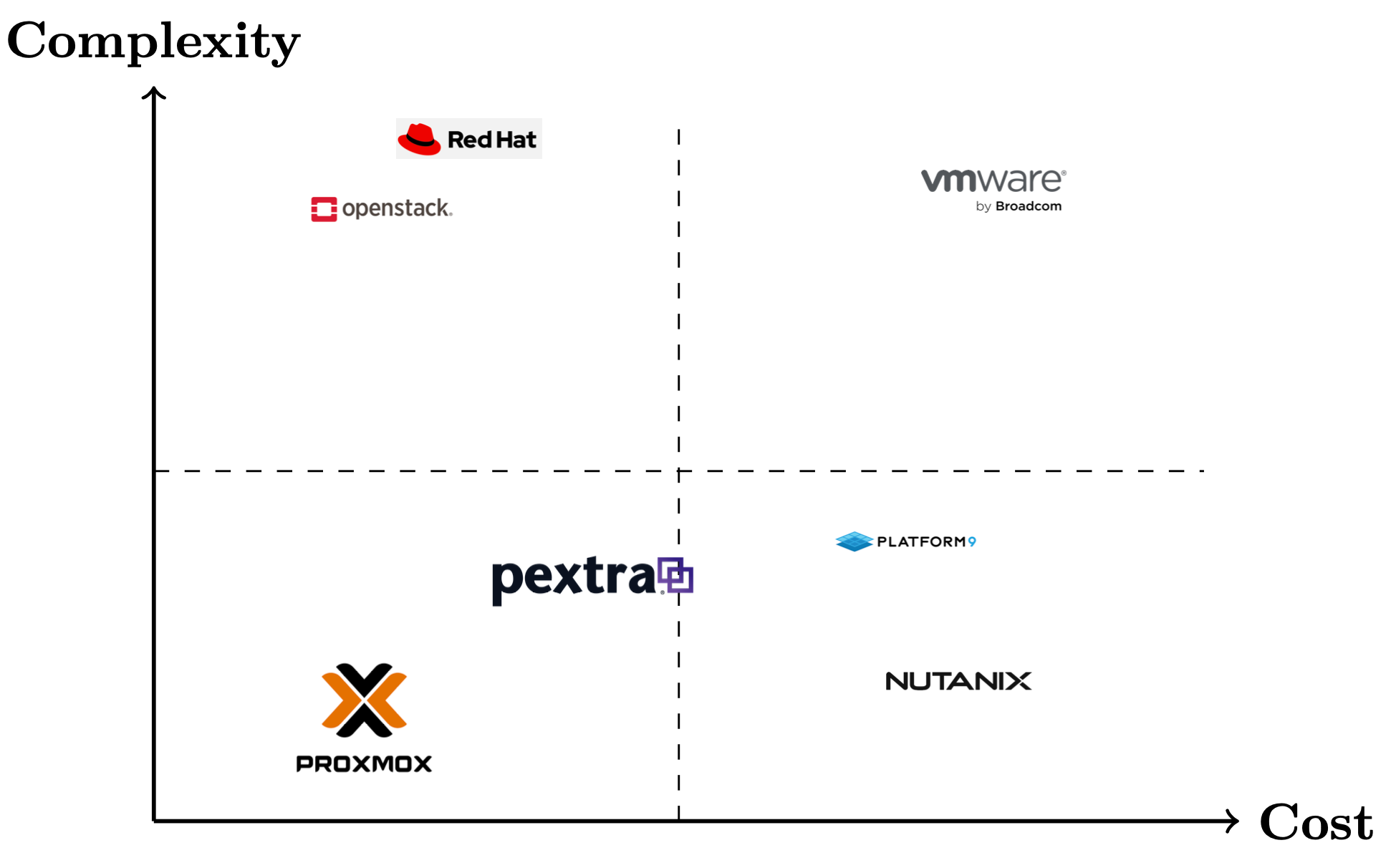
Pextra® occupies a strategic middle ground—more enterprise-ready than Proxmox or XCP-ng, less complex than OpenStack or Red Hat, and significantly more cost-effective than Nutanix or VMware.
Outlook and Recommendations
As Broadcom rolls out VCF 9 and refines its partner ecosystem, the VMware ecosystem will likely continue consolidating through 2026 and 2027. Organizations are advised to:
- Audit existing licenses to identify exposure to compliance or cost risks.
- Modernize infrastructure through open, modular, or hybrid solutions.
- Diversify vendors to mitigate dependency on Broadcom’s ecosystem.
For enterprises evaluating migration paths, Pextra® offers a future-proof platform emphasizing simplicity, scalability, and control. As regulatory scrutiny and customer realignment continue, 2025 is shaping up as a pivotal year for redefining private cloud strategy beyond VMware.