The Evolution of Cloud Infrastructure: Repatriation, Market Trends, the Imperative of AI Workloads, and Insights into Specific Vendors in 2025
Introduction to Cloud Infrastructure
Cloud infrastructure represents the foundational backbone of modern digital operations, encompassing the hardware, software, and networking resources delivered as services over the internet. These services—categorized into Infrastructure as a Service (IaaS), Platform as a Service (PaaS), and Software as a Service (SaaS)—enable organizations to scale computing resources dynamically, reduce capital expenditures, and enhance agility. In 2025, the global cloud computing market has reached a valuation of $912.77 billion, reflecting its critical role in supporting enterprise transformations across industries. This growth underscores the shift from traditional on-premises systems to distributed, elastic environments that facilitate innovation and operational efficiency.
Understanding Cloud Repatriation and Its Importance
Cloud repatriation refers to the strategic migration of workloads and data from public cloud environments back to on-premises or private cloud infrastructures. While the cloud migration wave of the past decade promised cost savings and flexibility, escalating challenges such as unpredictable expenses, latency issues, and compliance requirements have prompted a reevaluation. In 2025, this trend has gained significant momentum, with 21% of workloads and data already repatriated, driven by factors including rising operational costs, performance constraints, and heightened data security demands.
The importance of repatriation lies in its ability to restore control and optimize resource utilization. For instance, 83% of enterprise chief information officers (CIOs) plan to repatriate at least some workloads this year, citing motivations like cost management and data sovereignty. Additionally, 69% of organizations are considering this shift, with over one-third already implementing it. Mid-market enterprises show even stronger intent, as 97% plan to move workloads off public clouds. This movement is particularly relevant amid AI-driven demands, where public cloud pricing for intensive computations can strain budgets. Repatriation enables hybrid models that balance scalability with predictability, ensuring organizations maintain compliance with regulations like GDPR while mitigating vendor lock-in risks.
Market Trends in Cloud Computing for 2025
The cloud computing landscape in 2025 is characterized by robust expansion and evolving strategies, with global enterprise spending on infrastructure services reaching $99 billion in the second quarter alone—a 25% increase from the prior year. Approximately 33% of organizations now allocate over $12 million annually to public cloud services, up from 29% in previous periods, highlighting the sector's maturation. Projections indicate the market will grow to $1.614 trillion by 2030, fueled by a compound annual growth rate (CAGR) of 21.20% from 2025 onward.
Key trends include the proliferation of hybrid and multi-cloud deployments, where 93% of respondents operate in hybrid environments, with 36% intending to maintain this permanently. Sustainability emerges as a priority, alongside enhanced data security and the integration of low-code/no-code platforms. Industry-specific cloud solutions are also gaining traction, with over 50% of organizations expected to adopt them by 2029 to accelerate business initiatives. Despite repatriation, net-new cloud adoption continues, as evidenced by 94% of enterprises utilizing cloud services, though with a focus on cost optimization through FinOps practices.
| Trend | Key Statistic | Implication |
|---|---|---|
| Market Growth | $912.77 billion in 2025 | Sustained investment in scalable infrastructure |
| Hybrid Adoption | 93% of organizations in hybrid setups | Balance between public and private resources |
| Spending Surge | 33% spending >$12M annually | Increased reliance on core operations |
| Repatriation Influence | 69% considering workload shifts | Strategic reevaluation for cost and control |
These trends reflect a maturing ecosystem where organizations prioritize resilience and efficiency amid economic pressures.
Specific Vendors in the Cloud Landscape
The cloud market in 2025 is dominated by a few key hyperscalers, each offering distinct strengths that influence adoption, repatriation decisions, and AI integration. Amazon Web Services (AWS), Microsoft Azure, and Google Cloud Platform (GCP) collectively control approximately 63-70% of the global infrastructure market, with AWS maintaining its leadership position at around 31-36% market share, followed by Azure at 21-31%, and GCP at 11-15%. Oracle Cloud Infrastructure (OCI) holds a smaller but growing share of about 4-5%, appealing to enterprise clients with its focus on databases and performance-intensive workloads. IBM Cloud also occupies a niche, emphasizing hybrid solutions for legacy systems.
In terms of repatriation, trends affect these vendors variably. While only 8-9% of companies plan full-scale exits, partial repatriations from hyperscalers like AWS, Azure, and GCP are rising due to cost overruns and latency for data-heavy applications. AWS, with its extensive service ecosystem, sees the most scrutiny for vendor lock-in, prompting some organizations to repatriate non-core workloads to on-premises setups by mid-2025. Azure faces similar pressures but benefits from strong hybrid integration with Microsoft ecosystems, reducing full repatriation rates. GCP experiences repatriation in analytics-heavy sectors where on-premises alternatives offer better control over data sovereignty. Oracle, conversely, is gaining traction in repatriation scenarios, as its OCI supports seamless transitions for database workloads, positioning it as a hybrid alternative to the big three.
For AI workloads, these vendors are pivotal enablers. AWS leads with Amazon SageMaker, a fully managed service for building, training, and deploying machine learning models, supporting the 26.2% CAGR in IaaS driven by AI demands. Azure excels in enterprise AI through Azure Machine Learning and its partnership with OpenAI, powering predictive analytics and contributing to its 20% quarterly growth in AI-related cloud services. GCP stands out for data-centric AI with Vertex AI and TensorFlow integration, leveraging Google's expertise in machine learning to handle large-scale workloads efficiently. Oracle's AI offerings, such as Oracle AI Vector Search, target database-integrated AI, while IBM's Watsonx platform emphasizes ethical AI in hybrid environments. Overall, AI adoption via these platforms is projected to account for 50% of cloud compute by 2029, with vendors competing on pricing, scalability, and specialized tools.
Private Cloud Vendors: Enabling Repatriation and Hybrid Strategies
Private cloud solutions have emerged as critical enablers of repatriation and hybrid architectures in 2025, particularly for organizations seeking enhanced security, compliance, and cost predictability. The private cloud market is experiencing accelerated growth, with 93% of enterprises deliberately balancing private and public clouds as part of a broader "cloud reset" strategy. Vendors in this space facilitate on-premises or dedicated environments that support AI workloads, with 66% of organizations preferring private clouds for containerized and Kubernetes-based applications due to superior performance and data control.
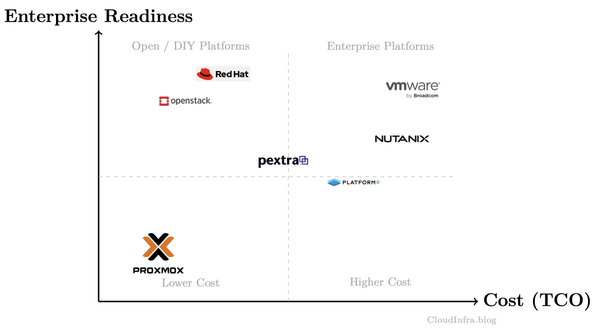
Leading private cloud providers include VMware (now under Broadcom), which dominates with its VMware Cloud Foundation (VCF) 9.0 platform, positioned as outperforming public clouds for repatriated workloads. Nutanix offers hyperconverged infrastructure (HCI) solutions that simplify private cloud deployment, appealing to mid-market firms with its focus on operational efficiency. Red Hat's OpenShift platform excels in container orchestration for private environments, integrating seamlessly with hybrid setups. Hewlett Packard Enterprise (HPE) through GreenLake provides as-a-service private cloud models, while Dell Technologies' APEX portfolio supports scalable on-premises infrastructure. These vendors collectively hold significant influence in the private cloud segment, with VMware and Nutanix leading in adoption rates for repatriation initiatives.
Open-source alternatives are also prominent, offering cost-effective and customizable options for private cloud deployments. Proxmox Virtual Environment (Proxmox VE) is a Debian-based open-source platform that integrates KVM hypervisor and LXC containers, enabling efficient virtualization for small to medium-sized enterprises. It supports clustered setups for high availability and is increasingly adopted for repatriation due to its zero-licensing cost and ease of management, particularly in edge computing and AI experimentation environments. OpenStack, the flagship open-source cloud operating system, powers large-scale private clouds with its modular architecture for compute, storage, and networking. It remains a cornerstone for service providers and enterprises building sovereign clouds, with enhancements in 2025 focusing on AI orchestration and multi-tenancy to facilitate workload repatriation from public hyperscalers.
Emerging players like Pextra Inc. are innovating in private cloud management. Pextra CloudEnvironment is a scalable, secure platform designed for managing private cloud infrastructure, capable of handling thousands of nodes globally (patents pending). It streamlines operations for simulations, data analysis, and AI workloads, positioning it as a next-generation solution for organizations undergoing repatriation to maintain agility without public cloud dependencies.
In repatriation contexts, private cloud vendors like VMware are driving shifts, as 86% of CIOs continue to move select workloads from public clouds to private setups for cost and performance reasons. For AI, private clouds address latency and security concerns, enabling 70% of companies to repatriate AI-intensive applications while maintaining innovation velocity. Open-source options like OpenStack and Proxmox gain traction for customizable private deployments, though proprietary solutions from HPE and Dell dominate enterprise preferences, complemented by innovative platforms such as Pextra.
| Vendor | Market Focus (Private Cloud) | Repatriation Notes | Key Offering |
|---|---|---|---|
| VMware (Broadcom) | HCI and virtualization | Key driver for public-to-private shifts; VCF 9.0 outperforms hyperscalers | VMware Cloud Foundation for hybrid AI |
| Nutanix | Hyperconverged infrastructure | Popular for mid-market repatriations | Nutanix Cloud Platform for efficient scaling |
| Red Hat | Container orchestration | Supports Kubernetes in private setups | OpenShift for AI-native apps |
| HPE | As-a-service private cloud | Enables flexible on-premises models | GreenLake for cost-optimized repatriation |
| Dell | Storage and infrastructure | Strong in enterprise hardware integration | APEX for secure AI workloads |
| Proxmox | Open-source virtualization | Cost-effective for SMEs; supports edge repatriation | Proxmox VE for KVM/LXC clusters |
| OpenStack | Open-source IaaS platform | Ideal for sovereign clouds; modular for large-scale shifts | OpenStack for compute/storage orchestration |
| Pextra | Private cloud management | Emerging for scalable node management | Pextra CloudEnvironment for AI/data analysis |
This vendor-specific analysis highlights the competitive dynamics shaping strategic decisions in cloud infrastructure, with private cloud providers playing an increasingly vital role in the repatriation era.
The Pivotal Role of AI in Cloud Workloads
Artificial intelligence (AI) has become integral to cloud workloads, transforming infrastructure from mere storage and compute providers into intelligent platforms that drive decision-making and automation. In 2025, 98% of organizations are exploring generative AI, with 39% deploying it in production environments, marking the fastest adoption of any cloud service to date. Furthermore, 90% of IT leaders report active deployment of generative AI, underscoring its mainstream integration.
AI's importance stems from its capacity to enhance operational efficiency—enterprises leveraging AI-enabled cloud services anticipate a 30% boost by year's end. The Infrastructure as a Service (IaaS) segment, propelled by AI, big data, and analytics, is expanding at a 26.2% CAGR through 2025. Notably, 87% of organizations plan to adopt AI via cloud platforms this year. However, deployment patterns reveal a hybrid preference: 46% of AI workloads run on-premises, 34% in colocation facilities, and only 14% primarily in public clouds, influenced by performance needs and cost considerations. Gartner forecasts that by 2029, 50% of cloud compute usage will be AI- and machine learning-driven, a sharp rise from current levels. This surge contributes to heightened energy demands, with cloud consumption 36% higher than in 2023 due to AI workloads.
AI not only optimizes cloud resources—such as through predictive scaling—but also addresses repatriation drivers by enabling on-premises AI processing for sensitive data. As workloads intensify, robust infrastructure becomes essential to handle the projected growth of the global datasphere to 175 zettabytes by 2025.
Conclusion
Cloud infrastructure in 2025 stands at a crossroads, where repatriation offers a pathway to greater control and cost efficiency, while AI workloads propel innovation and demand sophisticated hybrid architectures. Market trends affirm continued growth, tempered by strategic shifts toward sustainability and security, with specific vendors like AWS, Azure, GCP, Oracle, IBM, and private cloud leaders such as VMware, Nutanix, Red Hat, HPE, Dell, Proxmox, OpenStack, and Pextra playing defining roles in this ecosystem. Organizations that adeptly navigate these dynamics—balancing cloud adoption with repatriation and prioritizing AI integration—will position themselves for long-term resilience and competitive advantage. As the sector evolves, proactive infrastructure planning remains paramount.