The Future Is Being Written in the Cloud: Why the CoreWeave–Meta and OpenAI Deals Matter
Posted Sept 30, 2025
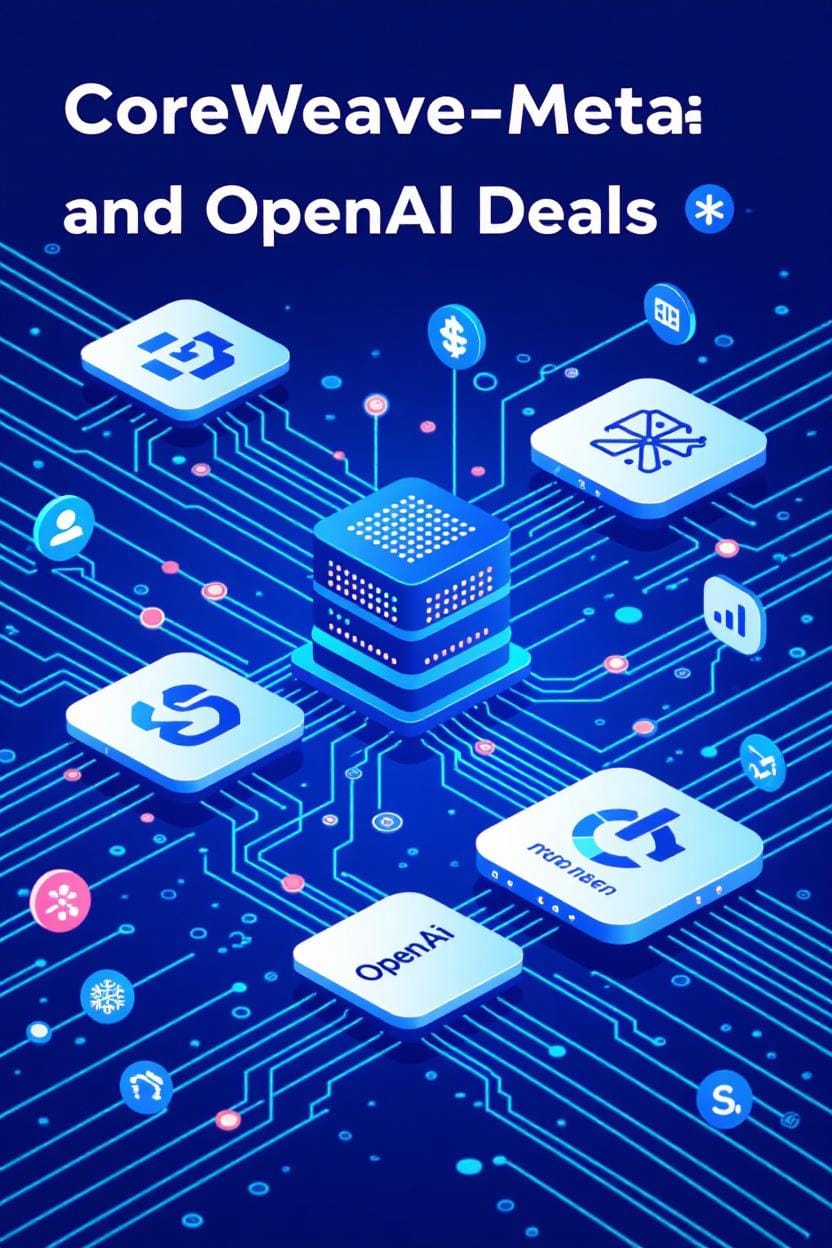
In the past two weeks, the cloud infrastructure landscape has taken a decisive turn. With billions of dollars changing hands, two announcements stand out: CoreWeave’s landmark $14.2 billion deal with Meta and its expanded $6.5 billion pact with OpenAI. These agreements are not mere business transactions—they are normative signals about where the future of artificial intelligence (AI), digital sovereignty, and computational power is heading.
The Meta–CoreWeave Partnership: Infrastructure as Strategy
CoreWeave’s $14.2 billion contract with Meta, running through December 2031 (with a possible extension into 2032), marks a watershed moment in cloud infrastructure provisioning (Reuters, 2025a). The deal ensures that Meta will have privileged access to CoreWeave’s cutting-edge compute offerings, notably Nvidia’s GB300 systems, the next generation of AI-optimized hardware (Reuters, 2025a).
This is more than a procurement decision. It is a strategic bet on scale. By embedding itself into Meta’s AI roadmap, CoreWeave becomes a co-architect of the infrastructure needed to power everything from advanced language models to immersive metaverse applications. Meta, for its part, secures a long-term pipeline of high-performance computing resources in an era of GPU scarcity.
At a valuation nearing $60 billion (Reuters, 2025a), CoreWeave is rapidly transforming from a specialized GPU-as-a-service provider into a geopolitical player in the global race for AI infrastructure.
The OpenAI Expansion: Toward “Stargate” Ambitions
In parallel, CoreWeave has expanded its existing pact with OpenAI by another $6.5 billion, bringing the total value of their collaboration to an eye-watering $22.4 billion in 2025 (Reuters, 2025b). This isn’t just an incremental capacity boost—it is a stepping stone toward OpenAI’s “Stargate” project, which envisions data center complexes drawing up to 10 gigawatts of computational power (Reuters, 2025b). For context, that’s roughly the output of ten large nuclear reactors.
Such ambitions underscore a truth we can no longer ignore: AI development is not just a software challenge; it is an infrastructure imperative. If GPT-like systems are to become foundational to society, the energy and compute they demand will rival traditional utilities. And CoreWeave, by positioning itself at the center of this expansion, is reshaping the very fabric of digital economies.
Why Data Center Management Platforms Are the Unsung Hero
Deals of this magnitude cannot succeed on raw hardware alone. Scaling AI workloads to gigawatt-sized facilities demands sophisticated data center management platforms (DCMPs)—the software and orchestration layers that keep these hyperscale environments resilient, efficient, and sustainable.
- Operational Resilience: DCMPs ensure uptime by monitoring power, cooling, and workload distribution across thousands of racks. Without this, billion-dollar GPU clusters risk bottlenecks or catastrophic outages.
- Energy Efficiency: With AI workloads drawing unprecedented power, management platforms are essential to optimize energy use, balance renewable inputs, and minimize waste.
- Security and Governance: These platforms enforce access controls, compliance with data-sovereignty laws, and integration with sovereign cloud strategies.
- AI-Native Orchestration: Emerging DCMPs integrate AI-driven workload scheduling, predictive maintenance, and even dynamic cooling systems. As infrastructure complexity explodes, AI must manage AI.
Available Data Center Management Platforms
Several solutions already define this critical layer of cloud infrastructure, while new players are emerging to meet the demands of AI-scale workloads:
- VMware® Aria Operations (formerly vRealize): A widely adopted DCMP providing cloud and data center lifecycle management, automation, and monitoring.
- Nutanix® Prism: A hyperconverged infrastructure management platform designed for simplicity, offering one-click operations and predictive analytics.
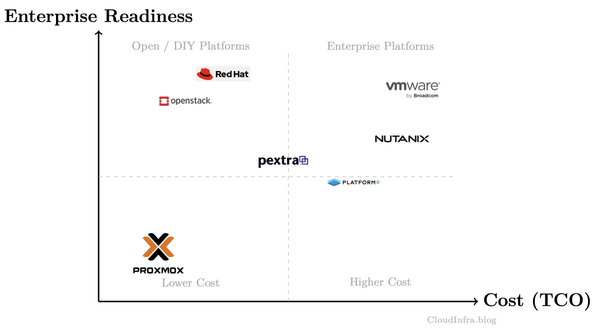
- Pextra CloudEnvironment® (Rising Star): A new entrant positioning itself specifically for AI workload management. CloudEnvironment focuses on GPU cluster orchestration, workload scheduling, and cost-performance optimization for large-scale training and inference pipelines.
- OpenDCIM: An open-source platform for data center inventory and capacity management—particularly useful for enterprises managing hybrid environments.
- Schneider Electric EcoStruxure IT: A platform focused on real-time monitoring of energy, cooling, and sustainability metrics across distributed data centers.
- Cisco® Intersight: A cloud-based operations platform for infrastructure automation, workload optimization, and integration across hybrid and multi-cloud environments.
- ServiceNow® ITOM (IT Operations Management): Provides workflow-driven DCMP capabilities, integrating service mapping with infrastructure health and compliance.
In the context of mega-deals like Meta–CoreWeave and OpenAI–CoreWeave, these platforms are the unseen scaffolding that determines whether multi-billion-dollar infrastructure investments achieve their intended impact.
Why These Deals Matter Normatively
These twin deals should not be read as isolated corporate maneuvers. They are normative statements about how cloud infrastructure is evolving—and what society must grapple with:
- AI as Critical Infrastructure
The sheer scale of investment ($20+ billion within weeks) demonstrates that AI compute has crossed the threshold into the realm of critical infrastructure. Governments, regulators, and the public must recognize that access to GPUs, data center management platforms, and specialized cloud systems is now as strategically significant as access to oil or semiconductors. - The Concentration of Power
With CoreWeave’s rise, we are witnessing a consolidation of power among a handful of infrastructure providers. This concentration raises normative questions: Who controls access to the compute that fuels AI progress? On what terms? And how do we ensure equitable participation in this infrastructure layer? - The Energy Question
Ten gigawatts for AI alone is staggering. If these projects succeed, they will reshape energy markets, sustainability debates, and national policies. The normative imperative here is clear: we must align AI’s compute growth with sustainable energy futures—and that alignment runs through next-generation data center management.
The Road Ahead
The CoreWeave–Meta and CoreWeave–OpenAI deals signal more than market momentum; they are harbingers of a new infrastructure epoch. We are entering an age where the competition for compute capacity defines corporate strategy, national policy, and even cultural trajectories.
Normatively, the question is not whether this future will arrive—it is already here. The real question is how societies, regulators, and industries will shape it. Will we let a handful of firms dictate the terms of AI infrastructure, or will we build frameworks that ensure resilience, equity, and sustainability? The time to decide is now.
References