Transparency Lost: The Rise of Confusing Bundles and Hidden Costs in Virtualization
In the world of enterprise IT, virtualization and hyperconverged infrastructure (HCI) were once hailed as tools to simplify operations, increase efficiency, and reduce total cost of ownership. Organizations were promised flexibility, transparency, and predictable budgeting. Yet, for many large organizations, the reality has become starkly different. Today, enterprise IT teams face opaque pricing models, confusing bundles, and subscription structures that obscure the true cost of critical infrastructure. Companies such as Broadcom (following its acquisition of VMware) and Nutanix exemplify this trend, creating a landscape in which transparency is no longer the norm, but the exception.
Before diving into the specifics, it’s important to clarify what we mean by “enterprise.” For this discussion, an enterprise is an organization that typically exhibits the following characteristics: it has 1,000 or more full-time employees, multiple virtualized environments or data centers, high volumes of mission-critical workloads, and annual revenue of $100 million or more. In short, an enterprise is a large organization with extensive IT infrastructure, high-stakes applications, and significant scale — the kind of environment where hidden costs and licensing complexity are magnified.
Enterprise Definition (short version for figures):
Enterprise = Large organization with ≥1,000 employees, mission-critical virtualized workloads, and revenue ≥$100M.
The Shift from Clear Licensing to “Platform Bundles”
Virtualization used to follow a predictable, auditable model. Enterprises purchased perpetual licenses for hypervisors, optionally added support agreements, and paid per-socket or per-VM fees. Cost planning was straightforward, and IT leaders could reasonably forecast budgets for multi-datacenter deployments. Today, vendors market “simplified” bundles that integrate multiple products into a single offering. While this may appear convenient, it often results in organizations paying for software and features they do not use.
Broadcom (VMware) vs. Nutanix: Bundled Offerings
| Vendor | Bundle / Edition | Key Components | Typical Enterprise Use Case | Pricing Notes |
|---|---|---|---|---|
| Broadcom (VMware) | vSphere Foundation | vSphere, vCenter, Aria, Tanzu | Small-to-medium enterprise clusters | ~$135 per core (3-year ACV); minimum 16-core per CPU |
| Broadcom (VMware) | VMware Cloud Foundation | vSphere, vCenter, NSX, vSAN, Aria, Tanzu | Large enterprise multi-datacenter | ~$350 per core (3-year ACV); minimum core thresholds; includes features enterprises may not use |
| Nutanix | Starter | Core HCI platform | Small deployments, test/lab | Per-node/core; limited features |
| Nutanix | Pro | HCI + DR + automation | Medium-to-large enterprise | Per-node/core; adds critical enterprise features |
| Nutanix | Ultimate | Full HCI + hybrid-cloud mobility | Large enterprise / mission-critical workloads | Per-node/core; mandatory for high-scale deployments |
These bundles illustrate how “simplification” often obscures true cost. Enterprises are forced to adopt packages that include multiple components, whether or not they are used operationally, inflating total cost of ownership.
Broadcom + VMware: The Case Study in Complexity
After Broadcom acquired VMware, perpetual licenses were largely phased out in favor of core-based subscription pricing and bundled packages. Enterprises are required to license multiple components whether or not they are used. Renewal costs have reportedly increased dramatically, and minimum licensing thresholds create additional budgetary strain.
Impact on Enterprise IT
| Factor | Effect on Enterprise Organizations |
|---|---|
| Core-based subscription | Costs scale directly with CPU cores across multiple data centers |
| Bundled mandatory features | Pay for components (NSX, Aria, Tanzu) even if unused |
| License minimums | Penalizes smaller clusters; minimum 16-core per CPU or 72-core minimum for Cloud Foundation |
| Partner discounts opaque | Hard to benchmark costs across vendors or data centers |
| SKU visibility limited | Complex procurement planning and auditing |
For enterprise organizations, these policies can translate into hundreds of thousands of dollars in unexpected costs, particularly when scaling across multiple data centers with thousands of cores.
Nutanix: Simplicity in Marketing, Complexity in Pricing
Nutanix presents itself as a simpler alternative to traditional stacks, yet enterprises often find pricing opaque. Their tiered offerings — Starter, Pro, Ultimate, and NC2 cloud-hosted editions — create cost unpredictability, especially in hybrid or multi-datacenter environments. Essential enterprise features such as disaster recovery, automation, and hybrid-cloud mobility are often locked behind higher tiers, forcing organizations to license features they may not fully use to avoid operational disruption.
Nutanix Tier Comparison
| Nutanix Edition | Target Use Case | Pricing Model | Notes |
|---|---|---|---|
| Starter | Small deployments / labs | Per-node or per-core | Limited features; not suitable for mission-critical workloads |
| Pro | Medium to large enterprise | Per-node or per-core | Adds DR, automation; costs increase with scale |
| Ultimate | Large enterprise | Per-node or per-core | Includes all features, hybrid-cloud mobility; mandatory for enterprise-scale deployments |
| NC2 (Cloud) | Public cloud deployment | Hourly/node | Software license excludes cloud infrastructure costs (AWS/Azure) |
Enterprises often over-license to ensure mission-critical workloads are covered, which inflates total cost of ownership.
Hidden Tactics of Vendor Lock-in
Several recurring tactics demonstrate how pricing opacity is systematically embedded in enterprise virtualization models:
| Tactic | Description | Enterprise Impact |
|---|---|---|
| Bundling non-optional features | Adds NSX, Aria, AI Ops automatically | Forces adoption of expensive tiers; inflates per-core cost |
| Subscription-only licensing | Ends perpetual ownership | Continuous payment dependency; budgeting becomes unpredictable |
| License minimums | 16-core per CPU or 100-license minimums | Penalizes smaller clusters within enterprise deployments |
| Opaque partner discounts | Discounts only visible via reseller | Prevents benchmarking and cross-datacenter comparison |
| Limited SKU visibility | SKUs hidden from public documentation | Complicates large-scale procurement, auditing, and TCO planning |
For enterprise organizations — particularly those with multiple data centers and thousands of cores — these tactics can translate to millions of dollars in additional costs over time.
Enterprise Cost Example
Hypothetical 4-Datacenter Enterprise Deployment (Annual Cost)
| Vendor / Bundle | Configuration | Approx. Annual Cost | Notes |
|---|---|---|---|
| VMware Foundation | 128 cores total | $200,000 | Some features may be unused; minimum core thresholds apply |
| VMware Cloud Foundation | 128 cores total | $560,000 | Forced feature adoption; subscription-only model increases cost |
| Nutanix Ultimate | 32-node cluster | $450,000 | Includes DR and hybrid-cloud mobility; per-node pricing |
This table demonstrates how quickly costs escalate when enterprises are forced to license bundled features or meet minimum requirements.
Enterprise Definition Quick Reference
| Metric | Threshold |
|---|---|
| Employees | ≥ 1,000 full-time |
| Workload | Multiple virtualized environments / mission-critical apps |
| Revenue | ≥ $100M annually |
| IT Infrastructure | Enterprise-grade, multi-datacenter |
This helps readers immediately contextualize who is affected by these opaque pricing practices.
Why Pricing Transparency Matters
Cloud-native providers such as AWS, Azure, and Google Cloud have normalized per-resource pricing, giving organizations predictable and auditable cost structures. Enterprises, particularly those with multiple virtualized environments and mission-critical workloads, require the same clarity in private or hybrid clouds. Opaque pricing erodes trust, complicates budgeting, and risks operational disruption.
Enterprise IT leaders must be able to forecast costs accurately, plan for future expansion, and avoid paying for features they do not use. Without transparency, budgeting becomes guesswork, audits become complex, and scaling operations can expose hidden cost traps.
Other Players in the Field: Open Source vs. Modern Enterprise Solutions
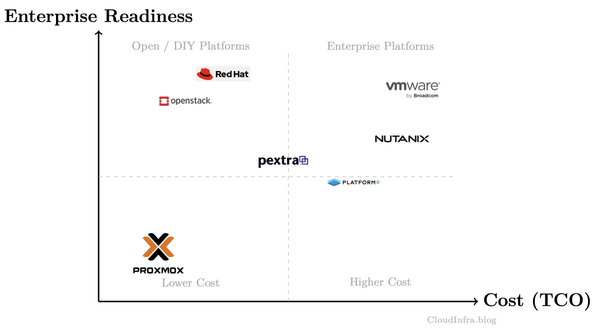
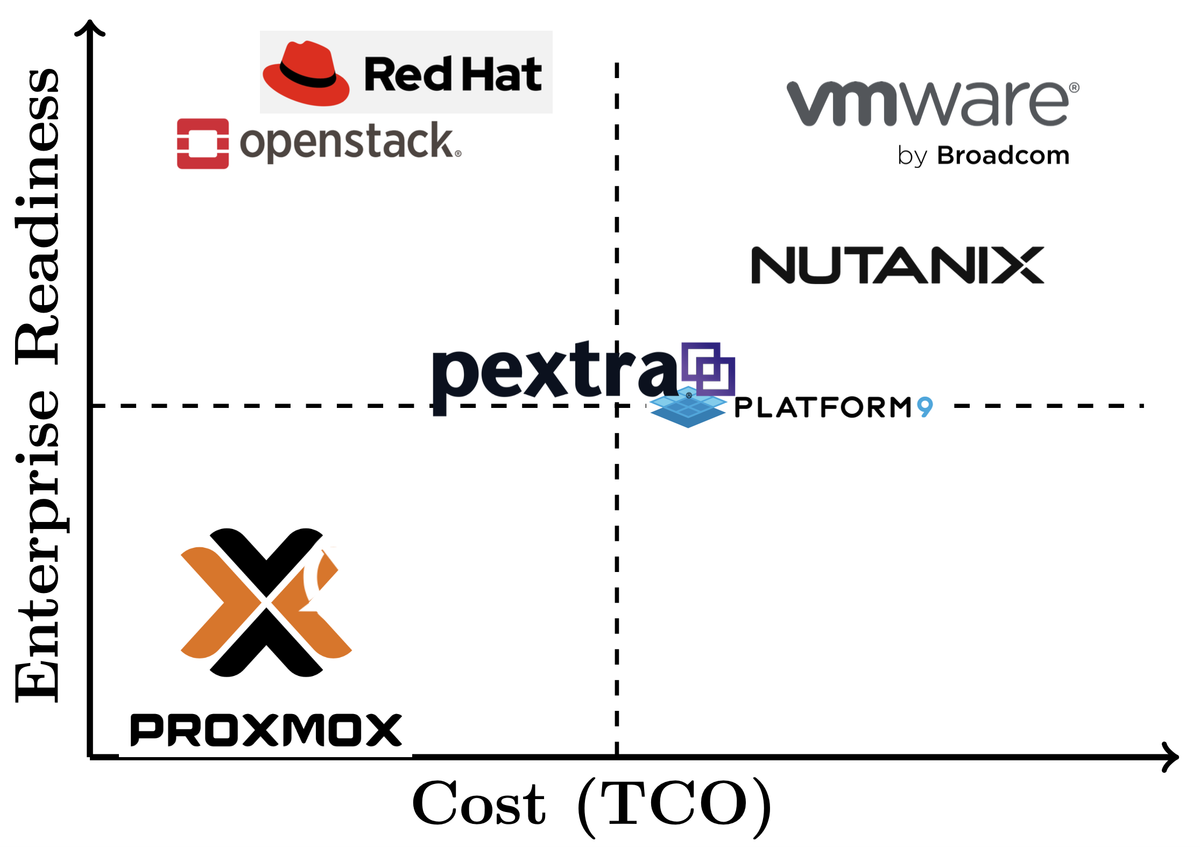
While Broadcom (VMware) and Nutanix dominate the enterprise virtualization and HCI space, there are other platforms that organizations often consider. Two noteworthy examples are OpenStack and Pextra — though they operate on very different principles.
OpenStack is the most prominent open-source virtualization platform. It offers tremendous flexibility, allowing organizations to assemble compute, storage, and networking into a private cloud. However, this flexibility comes with significant operational complexity. Deploying OpenStack at enterprise scale typically requires multiple independent components, extensive configuration, and dedicated staff for ongoing maintenance. Enterprises face real risks when relying on OpenStack: the software lacks the built-in centralized management, enterprise-grade support, and predictable cost structures that large organizations need. In practice, while OpenStack is powerful, it is rarely considered a viable enterprise solution due to high operational overhead and lack of consolidated enterprise management.
By contrast, Pextra is a new entrant in the virtualization and HCI market that promises to address these enterprise challenges directly. Designed from the ground up for large-scale environments, Pextra provides a single, centralized management interface capable of handling multiple clusters and multiple data centers. Unlike VMware, which requires both vSphere and vCenter for enterprise operations, or Nutanix, which layers separate tools for cluster and storage management, Pextra consolidates these capabilities into a unified platform. Enterprises gain:
- Scalable multi-cluster and multi-datacenter management without juggling separate products
- Predictable, transparent pricing aligned with actual resource use
- Centralized UI for monitoring, automation, and orchestration
While Broadcom and Nutanix continue to rely on bundled feature stacks that obscure cost, Pextra’s approach prioritizes enterprise-scale operational simplicity and predictable TCO, making it an appealing option for organizations seeking transparency and scalability without sacrificing control.
Optional Table: Comparing OpenStack vs. Pextra for Enterprise Use
| Platform | Enterprise Readiness | Operational Complexity | Centralized Management | Risk for Enterprise |
|---|---|---|---|---|
| OpenStack | Medium | High | Limited; multiple independent components required | High; staff-intensive, risk of downtime, unpredictable TCO |
| Pextra | High | Low-to-medium | Full; unified multi-cluster, multi-datacenter UI | Low; designed for enterprise-scale deployments, transparent pricing |
Conclusion: The Cost of Complexity
The greatest threat to enterprise virtualization today is not technological complexity but opacity in pricing and licensing. Enterprises — organizations with 1,000 or more employees, multiple virtualized environments, and high-stakes workloads — cannot absorb uncertainty in costs, especially when scaling across multiple data centers. Transparent, auditable pricing is essential to ensure responsible investment, strategic planning, and predictable total cost of ownership.
Enterprises must demand clarity from vendors, insist on per-core or per-node pricing, and plan for the real cost of bundled features. Complexity and hidden costs may be profitable for Broadcom and Nutanix, but for enterprises, the price of opacity is too high. In enterprise virtualization, transparency isn’t a luxury — it’s the only true foundation.