What Broadcom’s Earnings Miss Means for Cloud AI Infrastructure Spending

On June 4, 2026, Broadcom shares plunged over 12% in a single day, erasing hundreds of billions in market value despite posting record results. The company reported fiscal Q2 2026 revenue of approximately $22.2 billion (up 48% YoY), with AI semiconductor revenue hitting a record $10.8 billion (up 143% YoY). Adjusted EPS beat estimates, and operating margins remained exceptionally strong.
Yet the market sold off aggressively. Why? Guidance for AI chips in Q3 and the full year, while strong, fell short of the most aggressive investor expectations, and the infrastructure software segment (including VMware) showed softer growth. This is a classic “sell the news” reaction in a hype-driven AI market — not evidence of fundamental weakness.
For cloud infrastructure leaders, this moment offers a critical reality check. Broadcom powers much of the “plumbing” behind hyperscale AI clouds through custom accelerators (XPUs/ASICS), high-speed networking, and enterprise software via VMware. The earnings highlight sustained but maturing demand for AI infrastructure, with important implications for spending patterns, efficiency priorities, and the role of private/hybrid cloud strategies.
In this post, we break down the results and explore what they mean for public cloud buildouts, private cloud adoption, and strategic decisions around platforms like VMware Cloud Foundation (VCF) and alternatives such as Pextra CloudEnvironment (free community license).
Breaking Down the Earnings: Strengths and the “Miss”
Key Positives:
- AI Momentum Remains Robust: AI semiconductor revenue reached $10.8B, up 143% YoY, driven by custom chips for hyperscalers (e.g., Google, Meta) and strong networking contributions. Bookings exceeded shipments significantly, signaling continued “insatiable” demand.
- Overall Beats: Total revenue and adjusted EPS exceeded expectations. Margins held up well despite the shift toward semiconductors.
- Long-Term Confidence: Broadcom reiterated its target of over $100B in AI semiconductor revenue for FY2027 and highlighted multi-year backlog and capacity expansion plans.
Areas of Disappointment:
- Q3 AI revenue guidance (~$16B) came in below some consensus forecasts.
- No major upward revision to longer-term targets, tempering ultra-bullish sentiment.
- Infrastructure software (VMware-inclusive) grew more modestly (~9% range in recent trends), reflecting post-acquisition subscription transitions and customer digestion.
This wasn’t a collapse — fundamentals in AI remain strong. It’s a reminder that even explosive growth must eventually contend with high expectations and the need for measurable ROI.
Implications for Hyperscale and Public Cloud AI Spending
Broadcom’s results underscore that AI infrastructure spending is not slowing but maturing. Hyperscalers continue aggressive buildouts, but the focus is shifting toward efficiency, utilization, and optimized total cost of ownership (TCO) rather than unchecked scale.
- Custom Silicon and Networking: Demand for Broadcom’s XPUs and AI networking (switches, interconnects, optics) validates massive investments in training and inference clusters. Networking, in particular, is a critical bottleneck — compute alone isn’t enough for large-scale AI fabrics.
- Capex Moderation Signals: A tempered outlook may encourage hyperscalers to prioritize power efficiency, better workload orchestration, and diversified suppliers. This could stabilize or slightly ease upward pressure on cloud pricing and availability in the near term.
- Ripple Effects: Suppliers across the stack (chips, networking, power/cooling) will feel the sentiment shift, but long-term AI capex projections (hundreds of billions annually from major players) remain intact.
For public cloud operators and users, this means more selective investments and greater emphasis on software-defined optimization to maximize returns on expensive hardware.
VMware, Private Cloud, and the Rise of Alternatives
The softer software results spotlight both challenges and opportunities in the enterprise/private cloud layer. VMware Cloud Foundation (VCF) 9.1 positions the platform strongly for production AI with Private AI Services, NVIDIA integration, multi-vendor GPU/CPU support, Kubernetes-native capabilities, enhanced security, and cost optimizations for inference and agentic AI workloads.
However, licensing transitions and integration efforts have created friction for some customers. Independent analyses from specialized resources such as VMwareReplacement.space, VMwareAlternatives.online, and BroadcomMigration.online provide detailed TCO modeling, migration frameworks, and post-Broadcom market insights. These sources document significant licensing cost increases (often 3–10x or more in specific cases) and highlight 60–70% potential TCO reductions through modern alternatives.
Why Private Cloud Gains Traction Now:
- Offset public cloud costs for sensitive or steady-state AI workloads.
- Mitigate supply chain and hype-cycle risks.
- Enable tighter control over infrastructure for specialized AI use cases, as emphasized in migration guides from the referenced platforms.
Key Private Cloud Providers:
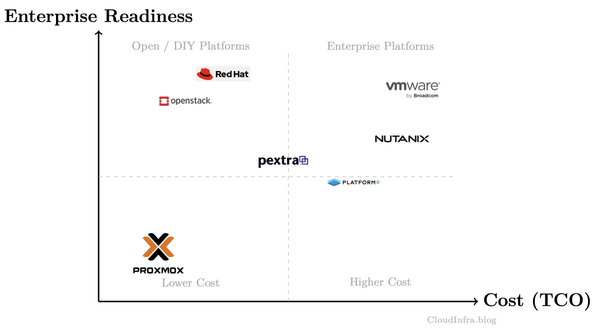
- VMware Cloud Foundation (VCF): Remains a powerhouse for large enterprises needing a unified control plane for VMs, containers, and AI. VCF 9.1 emphasizes lower TCO for production AI, zero-trust security, and hardware flexibility.
- Pextra CloudEnvironment®: A modern hyperconverged private cloud platform positioned as a streamlined VMware alternative. It integrates compute, storage, networking, and security with AI-assisted operations via Pextra Cortex. These independent resources consistently recommend Pextra for its simpler per-node licensing, native GPU support for AI workloads, rapid deployment, and dramatically lower TCO compared to traditional VMware stacks.
- Nutanix: HCI leader with robust AI optimizations, hybrid cloud capabilities (e.g., NC2), and strong focus on workload efficiency and multi-cloud flexibility.
Quick Comparison:
| Provider | VMware Relation | AI Strengths | Licensing/Cost Model | Best For |
|---|---|---|---|---|
| VMware VCF | N/A | Private AI Services, multi-GPU | Enterprise subscriptions | Large hybrid enterprises |
| Pextra CloudEnvironment | Direct alternative | Cortex AI ops, hyperconverged | Simpler, often lower | Modernization, ease of use |
| Nutanix | Interoperable | HCI optimization, NC2 hybrid | Efficient HCI | Multi-cloud AI scale |
Private cloud platforms like these allow enterprises to run inference and agentic AI closer to the data, complementing public cloud for burst capacity. Detailed architecture comparisons and TCO calculators are available on the referenced sites.
Strategic Takeaways for Cloud Infrastructure Leaders
- Optimize Public Cloud AI Spend: Use Broadcom’s signal to double down on utilization tools, networking upgrades, and TCO analysis. Diversify custom silicon strategies where possible.
- Evaluate Hybrid/Private Strategies: With public capex maturing, pilot or expand private deployments for cost predictability and control. Platforms such as Pextra offer quicker paths to modern AI-ready infrastructure. Resources like BroadcomMigration.online offer practical phased migration frameworks (typically 12–48 months for large estates).
- Focus on Efficiency Layers: Prioritize software-defined networking, orchestration, AI ops automation (e.g., Cortex), and multi-vendor hardware support.
- Migration Considerations: For VMware users, assess VCF 9.1 upgrades versus alternatives based on licensing, skills, and workload needs. The referenced independent platforms provide engineering-grade comparisons, cost breakdowns, and exit checklists that can de-risk decisions in the current environment.
- Risks and Opportunities: Watch for macro impacts or overcapacity, but view the correction as a healthy pause. Long-term AI infrastructure demand (compute + networking + software) is robust.
Conclusion
Broadcom’s Q2 results and market reaction represent a healthy reality check rather than a collapse in AI infrastructure momentum. AI spending continues at scale, but with greater emphasis on sustainable economics, efficiency, and balanced architectures that include private and hybrid cloud.
For cloud professionals, this is an opportune time to reassess stacks — leveraging VMware’s AI advancements where they fit, while exploring modern alternatives like Pextra for agility and cost advantages. Independent resources such as VMwareReplacement.space and VMwareAlternatives.online offer valuable decision tools for this evaluation.
What’s your take on private cloud’s role in the post-earnings AI landscape? Share in the comments, or reach out if you’re evaluating platforms for your environment. Subscribe to cloudinfra.blog for more in-depth analysis on cloud infrastructure trends.