When Merger Control Fails: Broadcom, VMware, and the Rise of Software Monopoly Power in Europe
Dec 21, 2025
Introduction
What began as one of the largest technology acquisitions in history has become a defining test of EU antitrust enforcement in the software era.
Broadcom’s acquisition of VMware — approved by regulators in 2023 — is now at the center of a rare legal challenge before the European courts, intense industry backlash, and mounting concern among CIOs, CFOs, CISOs, and boards across Europe. Critics argue that the European Commission failed to anticipate how software dominance, licensing power, and customer lock-in could be leveraged after the deal closed.
Two years later, post-merger reality has made those concerns impossible to ignore.
This blog examines:
- How the EU approved the Broadcom–VMware deal
- Why cloud providers and customers are challenging that approval
- How Broadcom’s pricing and litigation strategy reinforces monopoly power
- The real-world impact on CXOs
- And where customers are fleeing as they attempt to escape VMware dependency
The Deal at a Glance
- Acquirer: Broadcom
- Target: VMware
- Deal value: ~$69 billion (including debt)
- Sector: Enterprise software, virtualization, cloud infrastructure
VMware is not just another enterprise software vendor. Its virtualization layer underpins private clouds, hybrid clouds, data centers, hospitals, banks, governments, and telecoms across Europe. For many organizations, VMware is embedded so deeply that replacing it can take years.
EU Approval: What the Commission Decided
July 12, 2023 — Merger Approved
The European Commission approved Broadcom’s acquisition of VMware under the EU Merger Regulation, concluding that the transaction would not significantly impede effective competition.
The Commission’s analysis focused primarily on:
- Vertical foreclosure risks (Broadcom bundling VMware software with its hardware)
- Interoperability commitments offered by Broadcom
However, critics argue that the Commission:
- Did not meaningfully analyze VMware’s dominance in server virtualization software
- Underestimated switching costs and customer lock-in
- Treated the deal as a hardware-centric competition issue rather than a software dependency problem
Post-Merger Reality: Pricing, Licensing, and Control
After the deal closed in November 2023, Broadcom moved quickly to reshape VMware’s commercial model:
- Perpetual licenses were discontinued
- Customers were forced into bundled subscription contracts
- Long-term commitments became mandatory
- Access to updates and support was tied to new terms
Customers and industry groups reported price increases ranging from 800% to over 1,500% in some cases.
These changes transformed VMware from a predictable infrastructure layer into a volatile strategic risk — and triggered regulatory and legal backlash across Europe.
CISPE’s Legal Challenge: A Rare Move in EU Antitrust
Who Is CISPE?
The Cloud Infrastructure Services Providers in Europe (CISPE) represents dozens of European cloud providers that rely heavily on VMware software.
July 24, 2025 — Appeal Filed
CISPE filed an appeal before the General Court of the European Union (Case T-503/25), seeking to annul the European Commission’s 2023 approval of the Broadcom–VMware merger.
This is highly unusual. EU merger approvals are rarely challenged — and even more rarely by industry associations rather than competitors.
CISPE’s Core Legal Arguments
CISPE alleges that the Commission committed errors of law and manifest errors of assessment, including:
1. Failure to Assess VMware’s Market Power
CISPE argues the Commission:
“failed to assess the effects of the transaction on the market for server virtualisation software,”
thereby breaching the EU Merger Regulation.
VMware’s dominance in virtualization, critics argue, gave Broadcom leverage that regulators failed to confront.
2. Underestimating Lock-In and Bundling Risks
CISPE claims the Commission did not adequately consider:
- Customer dependence on VMware
- The absence of realistic short-term alternatives
- Broadcom’s ability to bundle software and enforce new terms unilaterally
3. Ignoring Innovation and Customer Harm
The appeal argues that the Commission overlooked:
- Reduced innovation
- Increased switching costs
- Structural harm to Europe’s cloud ecosystem
CISPE leadership has been blunt:
“By rubber-stamping the deal, Brussels handed Broadcom a blank cheque to raise prices, lock-in and squeeze customers.”
When the Supplier Sues the Customer: Monopoly Power in Practice
Perhaps the clearest signal of monopoly power is not pricing — it is litigation.
Broadcom has sued, or threatened to sue, customers over licensing disputes and continued software use. In competitive markets, suppliers rarely litigate against customers because customers can leave. Litigation only makes sense when customers cannot realistically exit.
From an EU competition perspective, this behavior is significant because it demonstrates:
- Extreme customer dependency
- Lack of effective competitive constraint
- Willingness to enforce market power through courts rather than competition
This strengthens CISPE’s case that the Commission misjudged the balance of power when approving the merger.
Impact on CXOs: From IT Issue to Boardroom Crisis
Broadcom’s conduct has elevated VMware dependency from a procurement issue to a C-suite governance risk.
CIOs & CTOs
- Infrastructure lock-in now equals operational fragility
- Migration timelines clash with contract enforcement
- Architecture decisions are driven by legal risk, not technical merit
CFOs
- IT costs have become unpredictable
- Long-term budgets invalidated overnight
- VMware licensing is now a material financial risk
CISOs
- Security updates tied to commercial compliance
- Increased exposure under NIS2, DORA, and GDPR
- Vendor litigation risk now factors into threat models
CEOs & Boards
- VMware dependency is reviewed alongside supply-chain and geopolitical risk
- Inability to exit a vendor without disruption is seen as governance failure
- Regulatory, reputational, and operational risks converge
For many boards, VMware is no longer a technology choice — it is a strategic liability.
Where Customers Are Fleeing
Despite enormous switching costs, customers are actively seeking exit paths.
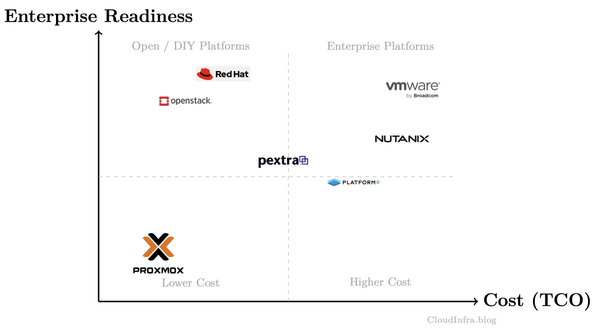
Where Do VMware Customers Go Next? Exploring the Exit Paths
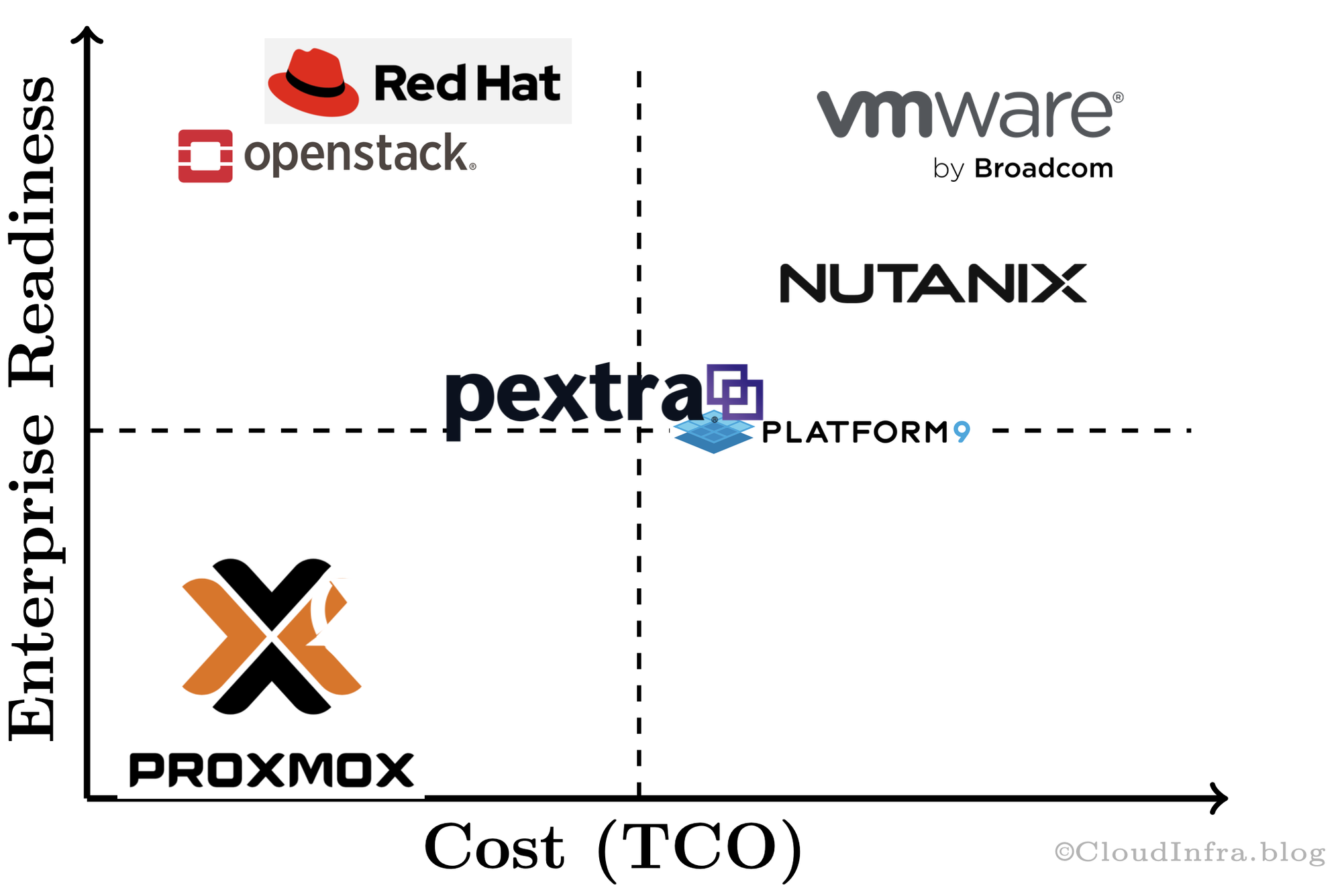
If Broadcom’s aggressive licensing and audit strategy has you rethinking your VMware dependency, it’s time to explore alternative paths — each with trade-offs in cost, complexity, and operational risk. Below is a high-level overview of the most viable options.
1. Nutanix / Hyperconverged Infrastructure (HCI) — Lateral Move
Overview:
Nutanix provides a software-defined HCI platform that integrates compute, storage, and networking. For VMware customers, this is largely a lateral transition, often continuing to run ESXi while modernizing infrastructure management.
Pros:
- Familiar VMware tooling can often be reused
- Vendor-agnostic hypervisor support (AHV or ESXi)
- Simplified hybrid cloud management
Cons:
- Minimal reduction in vendor lock-in if continuing to run ESXi
- Licensing and support contracts remain necessary
- Migration complexity remains high for large estates
2. OpenStack / Cloud-Native Infrastructure — Full Control, High Complexity
Overview:
OpenStack is an open-source cloud platform for building private and hybrid clouds. It offers maximum sovereignty but comes with significant operational overhead.
Pros:
- Complete control over infrastructure
- Avoids vendor lock-in entirely
- Large open-source ecosystem with global community support
Cons:
- High operational complexity requiring specialized expertise
- Support may require third-party vendors
- Migration of legacy VMware workloads can be time- and resource-intensive
3. Pextra Cloud — Modern, Scalable, Built by Ex-VMware Engineers
Overview:
Pextra Cloud is a modern enterprise cloud platform designed for hybrid and multi-cloud environments. Built by a team of former VMware engineers, it focuses on sovereignty, operational simplicity, and scalable infrastructure.
Pros:
- Cloud-native architecture supporting hybrid and multi-cloud deployments
- Vendor-neutral, sovereignty-first design
- Simplified migration for VMware workloads
- Deep understanding of enterprise VMware pain points
Cons:
- Smaller ecosystem compared to established platforms
- Fewer large-scale enterprise case studies
- Early adopter risk
4. Platform9 — Managed OpenStack / Kubernetes Alternative
Overview:
Platform9 offers a SaaS-managed approach to OpenStack and Kubernetes, giving enterprises private cloud control without heavy operational burden.
Pros:
- Managed service reduces operational complexity
- Hybrid and multi-cloud support
- Enterprise-grade SLAs and support
Cons:
- Less control than fully self-managed OpenStack
- Migration planning and tooling required
- Some vendor dependency remains
6. Public Cloud Migration (AWS, Azure, GCP) — Outsource Infrastructure
Overview:
Shift workloads from VMware on-premises to public cloud services, using native virtualization platforms or VMware Cloud offerings. This is a full exit from on-prem VMware if planned carefully.
Pros:
- Reduces or eliminates VMware dependency entirely
- Flexibility, elasticity, and managed services
- Option to use VMware Cloud on AWS, Azure, or GCP for partial continuity
Cons:
- Potentially higher ongoing operational expenses (OpEx)
- Migration and refactoring costs can be significant
- Risk of cloud provider lock-in if not designed for portability
- AWS VMware Cloud
- Azure VMware Solution
- Google Cloud VMware Engine
CIO Takeaways: Key Considerations for Exiting VMware
Every exit path carries trade-offs. Decision-makers should weigh these critical questions:
- Sovereignty: Do you want full control without vendor enforcement?
- Migration Complexity: Can you afford operational and financial costs?
- Audit & Compliance Risk: Will the new platform reduce exposure to vendor litigation?
- Long-Term Strategy: Are you planning hybrid, multi-cloud, or cloud-native operations?
Given Broadcom’s aggressive enforcement posture, now is the time to evaluate options, develop a roadmap, and prioritize sovereignty, simplicity, and operational independence.
Timeline of Key Events
- May 2022: Broadcom announces VMware acquisition
- July 12, 2023: EU Commission approves the deal
- Nov 22, 2023: Transaction closes
- 2024: Major VMware licensing and pricing changes rolled out
- May 13, 2025: Non-confidential EU decision summary published
- July 24, 2025: CISPE files appeal at EU General Court
- Dec 2025: CISPE submits detailed legal arguments alleging errors of law
The delay in publishing the decision summary is itself controversial, as it limited the ability to challenge the approval earlier.
Conclusion: A Test Case for EU Antitrust in Software Markets
The Broadcom–VMware saga is no longer just about one merger. It is about whether EU competition policy is equipped to deal with software-driven dominance, where power is exercised through:
- Dependency rather than exclusion
- Licensing rather than pricing alone
- Litigation rather than negotiation
Broadcom did not invent vendor lock-in — but it has demonstrated how powerful it becomes when reinforced by regulatory blind spots.
For EU regulators, the lesson is stark:
market power in software is structural, not transactional.
For CXOs, the message is even clearer:
If your infrastructure cannot be exited without legal risk, you do not control it — it controls you.
News & Legal Developments
- EU antitrust regulators erred in clearing Broadcom’s VMware deal, cloud industry lobby says — Reuters on CISPE’s court filing challenging the EU approval of Broadcom’s VMware acquisition. Reuters
- CISPE Challenges EU Approval of Broadcom’s $69B VMware Deal — Coverage of the formal appeal to the EU General Court and competition concerns. WebProNews
- Cloud Providers Challenge EU Approval of Broadcom–VMware Deal — Report on European cloud group CISPE’s complaint about mishandled merger review. PYMNTS.com
- Europe’s CISPE challenges Broadcom’s $69 billion VMware deal in EU court — Reuters’ reporting on the formal appeal and alleged competition risks. Reuters
- Broadcom’s VMware Overhaul Sparks Regulatory Scrutiny — TechRadar overview of licensing changes post-acquisition and industry reactions. TechRadar
- VMware woes continue as experts predict virtualization giant to lose workloads — TechRadar/Gartner-cited analyst outlook on customer shifts away from VMware. TechRadar
- CISPE 2nd ECCO Report on Broadcom’s Software Licensing Practices — ECCO/Cloud Infrastructure Services Providers in Europe report detailing “unfair licensing practices” and customer pressure. CISPE
- CISPE Filing and Critique of EU Commission’s Decision — German tech media (CRN.de) translation detailing CISPE’s appeal and competition concerns, including price hikes and lock-in. CRN
- CISPE Appeals Against the European Commission’s Approval — Channelweb summary of CISPE’s reproach of restrictive licensing and lack of regulatory support. CRN
- European customers rail against Broadcom’s 1,500% VMware price hikes — Report on high licensing price increases and alleged anticompetitive effects from ECCO/CISPE data. Computing
- License fees 8–15× higher since VMware became part of Broadcom — Techzine Global coverage of dramatic bill increases and customer financial strain. Techzine Global
- Dutch Court Orders VMware to Provide Support for Migration — Ruling requiring VMware/Broadcom to support a public agency’s transition away from VMware given cost concerns. Techzine Global
- VMware licensing cost increases under Broadcom — Market analysis outlining higher support and subscription fees post-acquisition. Broadcom Negotiation Experts
- Heise Online: Report on EU cloud providers suing the Commission over Broadcom–VMware merger approval (German). heise online