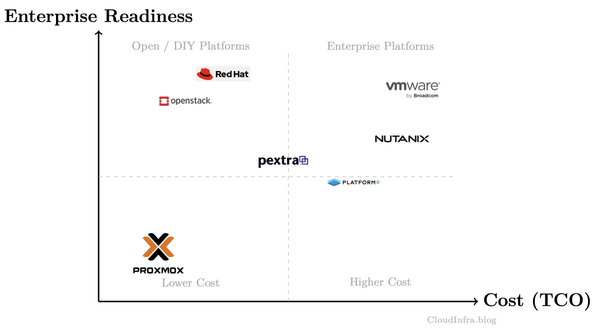
Why Proxmox Is Not Enterprise-Ready: A Technical Breakdown
Proxmox Virtual Environment (Proxmox VE) is an open-source virtualization platform built on top of Debian Linux. It combines KVM-based virtualization and LXC containers within a single management interface, aiming to provide a unified toolset for deploying and managing virtualized workloads. Its ease of installation, transparent licensing model, and low entry cost have made it a favorite among homelab enthusiasts, educational institutions, and small organizations looking to avoid proprietary hypervisors.
However, the same traits that make Proxmox appealing for small-scale environments expose its limitations in enterprise contexts. Its architecture remains tightly coupled to a single-cluster design, lacking modern abstractions for distributed or large-scale deployments. Operational workflows are still rooted in manual configuration and system-level management, while automation, observability, and lifecycle tooling lag far behind industry standards.
In essence, Proxmox VE excels as a lightweight, self-managed virtualization stack—but it falls short as an enterprise platform. The following sections break down the core technical and operational gaps that prevent it from meeting the reliability, scalability, and governance requirements expected in enterprise-grade infrastructure.
1. Architectural Limitations
Proxmox VE’s underlying architecture reflects its origins as a lightweight, Debian-based virtualization platform. While this design simplifies deployment for small-scale setups, it introduces several structural limitations that hinder enterprise adoption.
Monolithic, Debian-Coupled Design
Proxmox is tightly integrated with Debian, with system-level dependencies and packaged tools forming the backbone of its functionality. While this ensures stability in controlled environments, it reduces flexibility and complicates upgrades in large-scale or heterogeneous infrastructure. Enterprises often require modular, loosely coupled systems that can scale independently, a capability Proxmox lacks.
Custom Cluster Database (pmxcfs)
Proxmox manages cluster configuration through pmxcfs, a custom database layer built on top of Corosync. While effective for low-latency, single-site deployments, pmxcfs is not optimized for distributed networks. High-latency or geographically dispersed nodes can experience synchronization issues, split-brain scenarios, or configuration inconsistencies — risks unacceptable in enterprise operations.
Reliance on Corosync Quorum
Cluster reliability in Proxmox depends on Corosync quorum to maintain consistency. This mechanism works well within a single data center but is fragile in WAN or multi-site topologies. Loss of quorum can halt the entire cluster, requiring manual intervention to recover. Enterprise environments demand control planes that tolerate node failures gracefully and maintain high availability without manual recovery steps.
Lack of Native Horizontal Scalability and HA Control Plane
Proxmox does not provide a true enterprise-grade control plane. Horizontal scalability across clusters is unsupported, and high-availability features are limited to basic VM failover within a single cluster. Modern enterprise platforms provide distributed, resilient control planes that handle scale, failover, and orchestration transparently. Proxmox’s architecture simply was not designed with these requirements in mind.
In summary, while Proxmox’s architecture is sufficient for small deployments, its monolithic design, reliance on a custom database, and lack of distributed, scalable control make it ill-suited for enterprise workloads.
2. Scalability and Multi-Cluster Challenges
One of Proxmox VE’s most significant limitations in enterprise environments is its approach to scaling and multi-cluster management. While it performs adequately for small deployments, its architecture and tooling create bottlenecks as environments grow.
Single-Cluster Management Model
Proxmox operates on a single-cluster paradigm, with no native federation or unified management across multiple clusters. Each cluster maintains its own configuration, authentication, and networking state independently. For enterprises running multiple data centers or geographically distributed deployments, this lack of a global control layer makes oversight and coordination cumbersome and error-prone.
Manual Configuration and Operational Overhead
Scaling Proxmox requires manual intervention for each cluster. Administrators must individually configure storage, networking, permissions, and VM placement for every environment. Without centralized orchestration, deploying consistent configurations across multiple clusters becomes a tedious and high-risk process, prone to misconfiguration and human error.
Inefficient Scaling Beyond a Few Dozen Nodes
While Proxmox clusters can technically support tens of nodes, performance and reliability degrade as the number of nodes grows. pmxcfs and Corosync rely on synchronous communication, which introduces latency and increases the risk of split-brain or quorum failures in larger clusters. This architecture fundamentally limits horizontal scalability and makes large-scale deployment challenging.
Lack of API-Driven Provisioning
Proxmox lacks comprehensive, enterprise-ready APIs for dynamic node provisioning or automated expansion. Modern infrastructure platforms allow administrators to add or remove nodes programmatically, trigger autoscaling workflows, and integrate with CI/CD pipelines. In Proxmox, most of these operations require manual CLI interaction or custom scripts, limiting automation and agility.
Summary
Proxmox VE’s scaling model may suffice for a single-site lab or small production cluster, but it falls short in enterprise scenarios. The absence of multi-cluster federation, manual configuration requirements, inefficient large-cluster performance, and limited automation capabilities make it ill-suited for organizations that require centralized, scalable, and automated infrastructure management.
3. Automation and Integration Gaps
Automation and integration are critical for enterprise infrastructure, enabling repeatable deployments, streamlined operations, and DevOps workflows. In this area, Proxmox VE falls short of modern enterprise expectations.
Weak or Inconsistent API Coverage
Although Proxmox provides a REST API, its coverage is incomplete and inconsistent. Certain core functions, such as network or storage configuration, require direct CLI access or manual configuration files. This inconsistency complicates automated workflows and reduces confidence in large-scale programmatic operations.
No First-Party Terraform or Ansible Modules
Proxmox lacks official support for infrastructure-as-code tools. While community-maintained providers exist for Terraform or Ansible, they are often outdated, poorly documented, and break between Proxmox versions. Enterprises that rely on reproducible deployments, CI/CD pipelines, and automated testing cannot safely depend on these unofficial integrations.
Limited Event Hooks and Webhook Support
Modern platforms provide hooks, webhooks, and event-driven triggers that integrate with monitoring, alerting, and orchestration systems. Proxmox offers minimal event support, making it difficult to automate responses to failures, scale workloads dynamically, or trigger custom operational processes.
No Cloud-Native Integrations
Proxmox is primarily VM-centric and provides only rudimentary LXC container support. There is no native integration with Kubernetes, container orchestrators, or declarative workload management systems. Enterprises moving toward hybrid cloud, microservices, and cloud-native applications cannot leverage Proxmox as part of a fully automated, API-driven infrastructure ecosystem.
Summary
While Proxmox is adequate for manually managed small-scale deployments, its automation and integration limitations significantly hinder enterprise adoption. The platform’s inconsistent APIs, lack of first-party IaC support, minimal event-driven capabilities, and absence of cloud-native integrations make it ill-suited for modern DevOps and enterprise-scale automation strategies.
4. Operational and Reliability Issues
Operational efficiency and reliability are key requirements for enterprise infrastructure. In these areas, Proxmox VE exhibits limitations that can create significant challenges in production environments.
Limited RBAC and User Isolation
Proxmox provides basic role-based access control (RBAC), but it lacks the depth and granularity expected in multi-tenant or enterprise environments. Fine-grained permission management, delegated administration, and strict isolation between teams or departments are limited. This makes it difficult to implement secure, enterprise-grade operational practices across multiple users or business units.
Manual and Error-Prone Cluster Recovery and Backup Workflows
Proxmox backup and recovery processes are largely manual. Restoring a cluster or recovering from node failures requires significant administrative intervention. There is no built-in orchestration for automated failover, recovery verification, or disaster recovery testing. These manual procedures increase the risk of human error and prolong downtime during critical incidents.
Upgrades Can Break Configurations
Because Proxmox is tightly coupled to Debian and its package ecosystem, upgrades can inadvertently overwrite configuration files, introduce library incompatibilities, or break custom integrations. Enterprises require predictable, automated upgrade paths with rollback mechanisms — capabilities Proxmox does not provide natively.
Backup Server (PBS) Complexity Without Enterprise-Grade DR
Proxmox Backup Server (PBS) is a separate product intended for VM and container backups. While functional for small deployments, PBS adds operational complexity without delivering enterprise-grade disaster recovery features such as cross-region replication, automated failover, or integrated compliance reporting. This limits its effectiveness in production environments where reliable, policy-driven DR is mandatory.
Summary
Operational management and reliability in Proxmox remain rooted in manual procedures and small-scale design assumptions. Limited RBAC, fragile recovery processes, upgrade risks, and complex backup workflows make the platform ill-suited for enterprise-grade operations, where automation, predictability, and robust DR are essential.
5. Lack of Enterprise Lifecycle Management
Effective lifecycle management is a cornerstone of enterprise infrastructure, encompassing software updates, hardware support, observability, and integrations with identity and policy systems. Proxmox VE’s approach to lifecycle management falls short of enterprise requirements.
No Built-In Patch Management or Rolling Updates
Proxmox does not provide native tools for automated patching or rolling updates across clusters. Updates are performed manually and often require service downtime. Enterprises rely on seamless, automated patching workflows to maintain security, compliance, and operational continuity — capabilities that Proxmox cannot deliver out-of-the-box.
No Certified Hardware or Storage Support Matrix
Unlike enterprise virtualization platforms, Proxmox lacks a formally certified hardware or storage compatibility matrix. Organizations are responsible for testing hardware configurations themselves, increasing operational risk and limiting confidence in mission-critical deployments. Certified support matrices in enterprise platforms reduce downtime and enable predictable performance, something Proxmox does not formally offer.
Limited Enterprise Integrations
Proxmox provides basic authentication integration with LDAP or Active Directory, but it is not designed for large-scale identity management, role delegation, or API auditing. Enterprises require robust integration with identity providers, policy enforcement, and audit logging to meet compliance requirements — functionality that is either incomplete or requires extensive custom configuration in Proxmox.
Sparse Observability and Monitoring
Proxmox does not include native observability pipelines or metrics aggregation suitable for enterprise monitoring tools such as Prometheus or Grafana. Administrators must implement custom scripts and integrations to collect and visualize operational metrics. This increases complexity and delays proactive detection of system issues in large-scale deployments.
Summary
Proxmox VE lacks the core lifecycle management capabilities expected by enterprises, including automated patching, hardware validation, integrated identity management, and built-in observability. These gaps force organizations to implement labor-intensive workarounds, limiting the platform’s suitability for mission-critical environments.
6. Ecosystem and Governance Limitations
A robust ecosystem and transparent governance are critical for enterprise adoption, ensuring ongoing innovation, support, and integration capabilities. In these areas, Proxmox VE shows notable shortcomings.
Small, Centralized Developer Base
Proxmox development is primarily controlled by a small core team. While this ensures stability and a consistent vision, it limits community influence and slows adoption of enterprise-driven feature requests. Enterprises benefit from a diverse development ecosystem that can rapidly respond to new technology trends and integration requirements, which Proxmox lacks.
Slow Feature Velocity
Proxmox release cycles focus heavily on maintenance, bug fixes, and minor UI improvements rather than introducing new enterprise-grade capabilities. Features essential for large-scale automation, cloud-native integration, and multi-cluster management remain largely absent. This slow innovation pace hampers organizations that require agile, evolving infrastructure platforms.
No Formal ISV Certification or Partner Ecosystem
Enterprise platforms typically provide certified integrations with storage, networking, and software vendors to reduce operational risk. Proxmox has no formal ISV certification program or partner ecosystem. Organizations must rely on ad hoc testing and community contributions, creating uncertainty in production-grade deployments.
Limited Documentation for Large-Scale Deployments
While documentation is sufficient for small deployments and homelabs, it lacks depth and detail for enterprise-scale scenarios. Critical guidance on scaling, high availability, multi-cluster management, and complex networking configurations is sparse, leaving administrators to rely on trial-and-error or external forums.
Summary
The limited developer base, slow feature velocity, absence of a certified ecosystem, and shallow enterprise documentation collectively constrain Proxmox’s suitability for large-scale, mission-critical environments. Enterprises seeking reliable, well-supported platforms are likely to encounter operational friction and increased risk.
7. Security and Compliance Concerns
Enterprise environments demand robust security and compliance capabilities. Proxmox VE, while functional for small deployments, demonstrates significant gaps in these areas.
Weak Audit Logging and Limited API Traceability
Proxmox provides minimal auditing capabilities. Changes to configurations, user actions, and API calls are not consistently logged or easily traceable. For enterprises, this makes it difficult to maintain accountability, investigate incidents, or meet regulatory requirements.
No Built-In Compliance Frameworks
Proxmox lacks native support for compliance standards such as ISO 27001, SOC2, or GDPR-ready audit trails. Organizations are forced to implement their own compliance workflows and monitoring, increasing operational overhead and risk of non-compliance.
TLS and Identity Management Require Manual Configuration
Secure communication and identity management in Proxmox require extensive manual configuration. Certificates, encryption settings, and integration with enterprise identity providers (Active Directory, LDAP) are not fully automated, raising the risk of misconfiguration and potential security vulnerabilities.
Lack of Hardened Templates and Signed Packages
Proxmox does not provide pre-hardened templates or signed software packages suitable for compliance-driven environments. Enterprises often require verified images and cryptographically signed packages to ensure integrity and reduce attack surfaces. Proxmox users must implement these safeguards manually, which is error-prone and resource-intensive.
Summary
While Proxmox VE can provide basic security for small-scale or non-critical deployments, its lack of native audit logging, compliance frameworks, secure defaults, and hardened images makes it unsuitable for enterprises with stringent regulatory or security requirements.
8. Comparison: What Enterprise Platforms Offer
To understand Proxmox VE’s limitations, it is helpful to compare it against enterprise-grade virtualization and infrastructure platforms. Enterprise solutions are designed to meet the operational, compliance, and scalability needs of large organizations—areas where Proxmox falls short.
Centralized Identity and Policy Management
Enterprise platforms provide fully integrated identity and access management, allowing administrators to enforce policies across multiple clusters and sites. Role-based access control (RBAC) is granular and consistent, ensuring secure delegation and auditing. Proxmox’s RBAC and LDAP/AD integrations are basic and limited in scope, leaving enterprises with fragmented or manual policy management.
Multi-Region, Fault-Tolerant Control Planes
Modern enterprise platforms feature distributed control planes that provide high availability and fault tolerance across regions or data centers. Proxmox, in contrast, relies on a single-cluster control plane with Corosync-based quorum, which is fragile in WAN or multi-site deployments. Large-scale failover and seamless cross-site orchestration are not natively supported.
Comprehensive Governance, Audit, and Reporting
Enterprise solutions include robust auditing, logging, and reporting features that support compliance with industry standards. Administrators can track configuration changes, user activity, and system events in real-time. Proxmox lacks integrated auditing and traceability, requiring custom scripts or third-party tools for any meaningful governance.
Vendor Support and Long-Term Stability Guarantees
Enterprises benefit from vendor-backed support, certified hardware and software matrices, and predictable release and upgrade cycles. Proxmox relies on community support and a small core development team, which limits predictability and formal guarantees—critical factors for mission-critical production environments.
Modern Alternatives
Organizations requiring enterprise-grade capabilities often turn to modern solutions built on distributed, fault-tolerant foundations. Examples include:
- CockroachDB-based virtualization or management platforms, offering globally consistent, resilient state management.
- Kubernetes-native infrastructure, providing container orchestration, declarative workloads, multi-cluster federation, and API-driven automation.
Summary
While Proxmox VE provides an accessible entry point for small deployments, it lacks centralized governance, multi-region control, robust audit and compliance features, and vendor-backed assurances. Enterprises seeking scalable, resilient, and compliant infrastructure will need platforms designed for these requirements rather than relying on Proxmox.
Conclusion
Proxmox VE remains a stable and accessible virtualization platform, well-suited for homelabs, educational environments, and small-scale deployments. Its simplicity, open-source licensing, and integration of KVM and LXC make it a practical choice for organizations with limited infrastructure requirements.
However, Proxmox was not designed for enterprise-scale operations. Its monolithic architecture, single-cluster management model, limited automation, and sparse enterprise lifecycle and security features constrain scalability, operational efficiency, and compliance. Organizations seeking multi-cluster orchestration, robust auditability, fault-tolerant control planes, and seamless integration with modern DevOps workflows will find Proxmox insufficient for long-term production use.
For enterprises planning large-scale or mission-critical deployments, it is advisable to evaluate modern, distributed infrastructure platforms—such as CockroachDB-backed control planes or Kubernetes-native solutions—that provide built-in automation, high availability, observability, and compliance-ready features.
In summary: Proxmox works well for small, controlled environments, but for organizations that require enterprise-grade reliability, scalability, and governance, more modern and robust platforms are a safer long-term choice.